
What We'll Build Today
Reactive vs Predictive Scaling Algorithms with live performance comparison
Multi-dimensional Scaling Engine that considers CPU, memory, and custom metrics
Real-time Autoscaling Visualizer showing scaling decisions as they happen
Production-ready Docker Demo with chaos engineering capabilities
The Moment Your Autoscaler Becomes Your Enemy
You've just deployed your shiny new autoscaling configuration. CPU threshold: 70%. Scale-out cooldown: 5 minutes. Scale-in cooldown: 10 minutes. It looks perfect in testing, but at 3 AM on Black Friday, your system starts oscillating wildly—scaling up, hitting resource limits, scaling down, overloading remaining instances, then scaling up again in an endless dance of instability.
This scenario haunts production engineers because most autoscaling implementations focus on the mathematics of thresholds while ignoring the physics of distributed systems. The real challenge isn't knowing when to scale—it's understanding the temporal dynamics of how your scaling decisions interact with load patterns, deployment strategies, and the hidden feedback loops that emerge at scale.
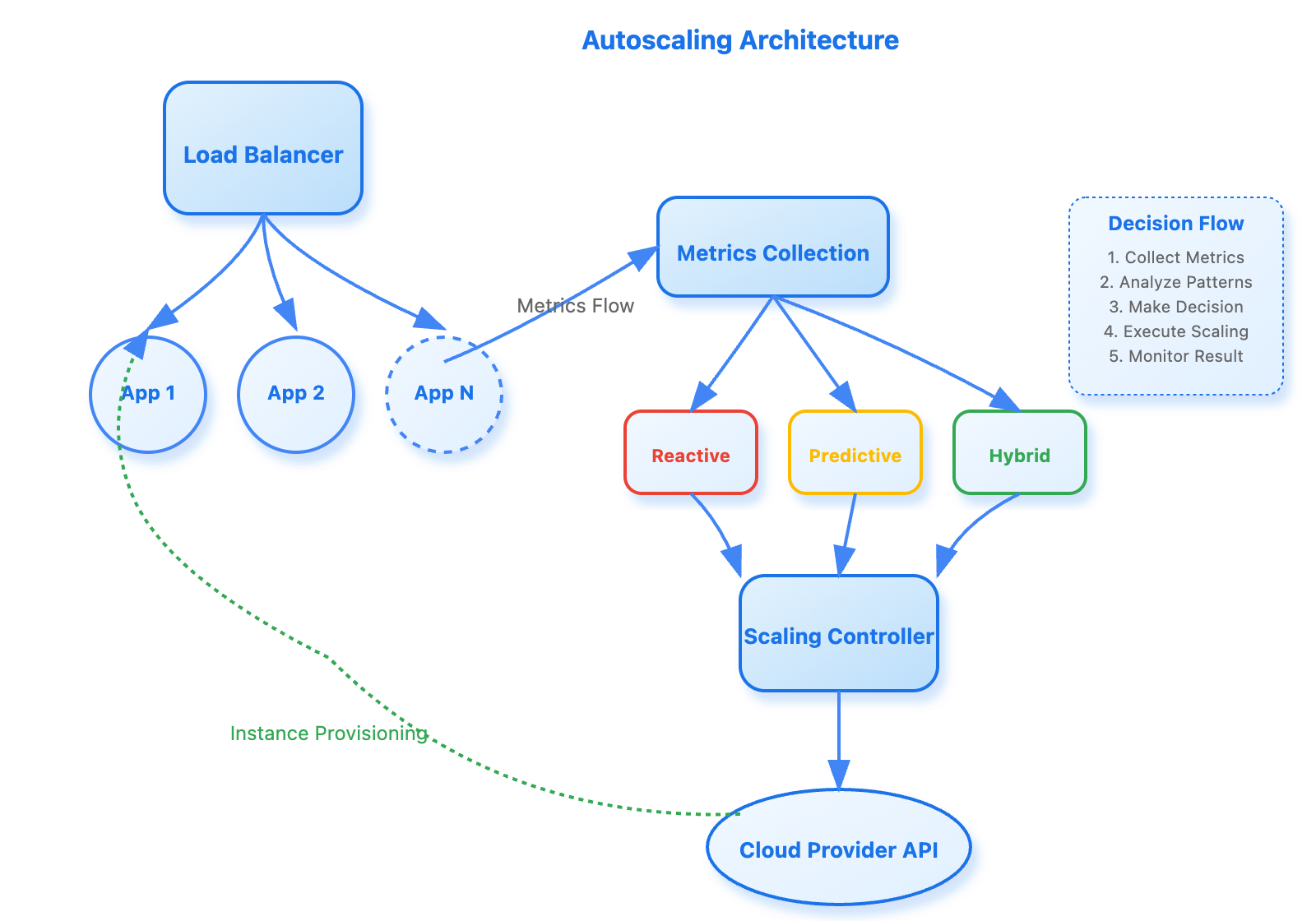
📊 [ Autoscaling Architecture ]
