🎯 What We'll Cover Today
By the end of this deep dive, you'll master bulkhead isolation through both theoretical understanding and hands-on implementation. Here's our learning journey:
🔧 Implementation Agenda:
Four Isolated Microservices with dedicated resource pools (Payment, Analytics, User Management, Notification)
Real-Time Monitoring Dashboard showing isolation effectiveness under various failure scenarios
Failure Injection System for testing bulkhead boundaries and cascade prevention
Multi-Layer Resource Isolation demonstrating thread pools, connection pools, and memory boundaries
Production-Grade Observability with metrics, logging, and visual feedback loops
This isn't a toy example—we're building enterprise patterns used by Netflix, Amazon, and Google to achieve fault isolation at hyperscale.
When One Bad Actor Brings Down Everything
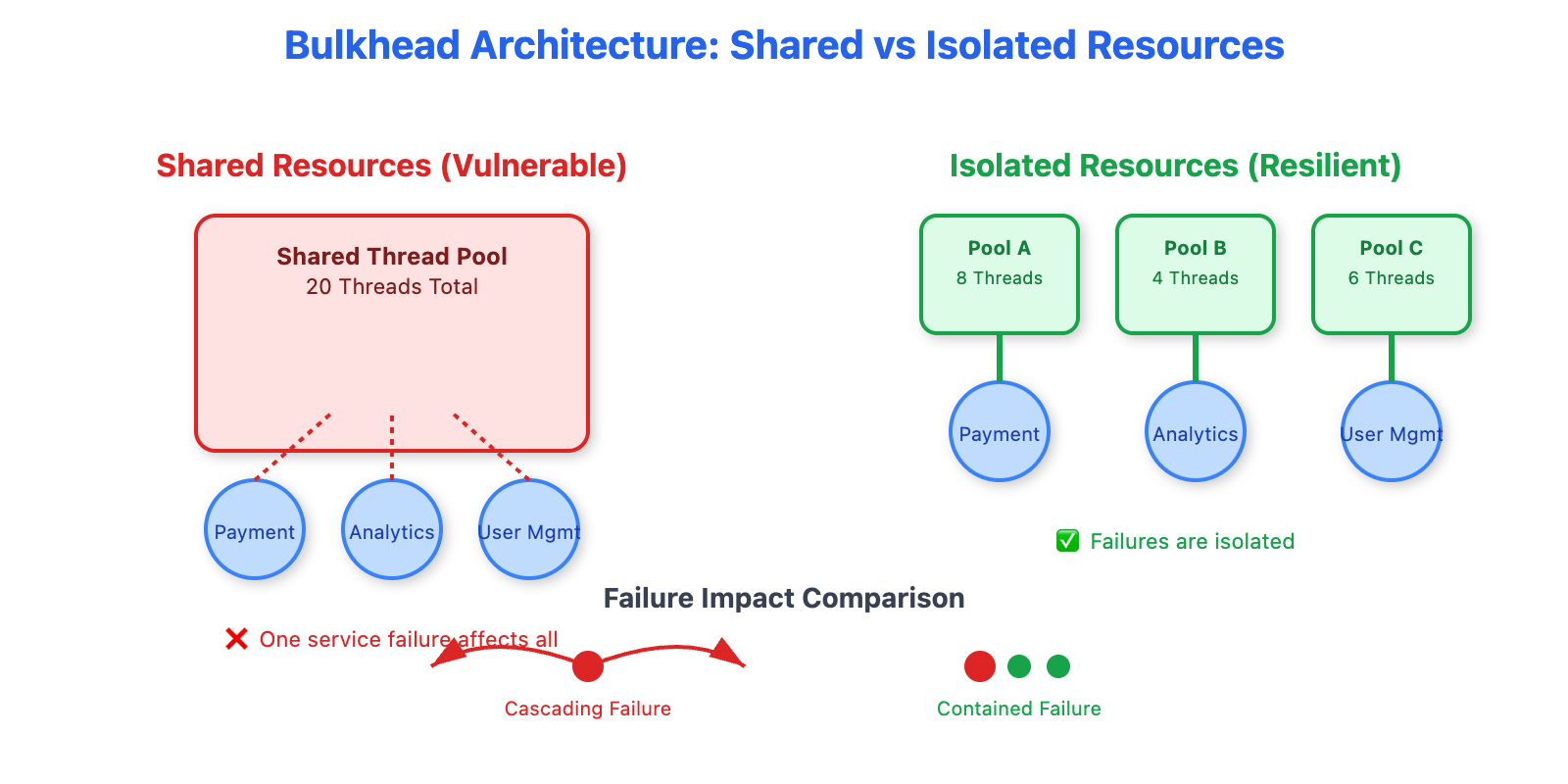
Your payment service just crashed. Not because of a bug in the payment logic, but because your analytics reporting system decided to fetch six months of transaction data, exhausting the shared database connection pool. Suddenly, customers can't check out, your revenue stream stops, and you're explaining to executives why a non-critical analytics query killed your most important business function.
This scenario plays out daily across the industry. The fundamental insight that separates resilient systems from fragile ones isn't about preventing failures—it's about containing their blast radius through deliberate isolation boundaries.
Welcome to the world of bulkheads and isolation patterns, where the maritime principle of compartmentalized ship design becomes your weapon against cascading system failures.
The Bulkhead Metaphor: More Than Just a Pretty Analogy
📊 [Bulkhead Architecture Comparison]