Introduction
Your on-call alert fires at 2 AM. A junior engineer debugging a payment failure copies a log snippet into Slack to get help. That log contains a customer’s full credit card number, email address, and home address. It’s now sitting in a SaaS messaging platform’s servers, outside your security perimeter, accessible to dozens of people — and you’ve simultaneously violated GDPR Article 32, PCI-DSS Requirement 3, and your customer’s trust. The engineer did nothing malicious. They did exactly what engineers do. The system failed to protect them from the failure mode.
Automated PII redaction in logs and backups is not a nice-to-have. It is the structural defense that makes compliance survivable at scale.
How PII Ends Up in Logs
The mechanism is mundane: developers log objects. A User object gets serialized into a log line during an exception handler, and suddenly {name: "Jane Doe", ssn: "123-45-6789", email: "[email protected]"} is sitting in your ELK stack, replicated to three availability zones, backed up nightly, and retained for 90 days.
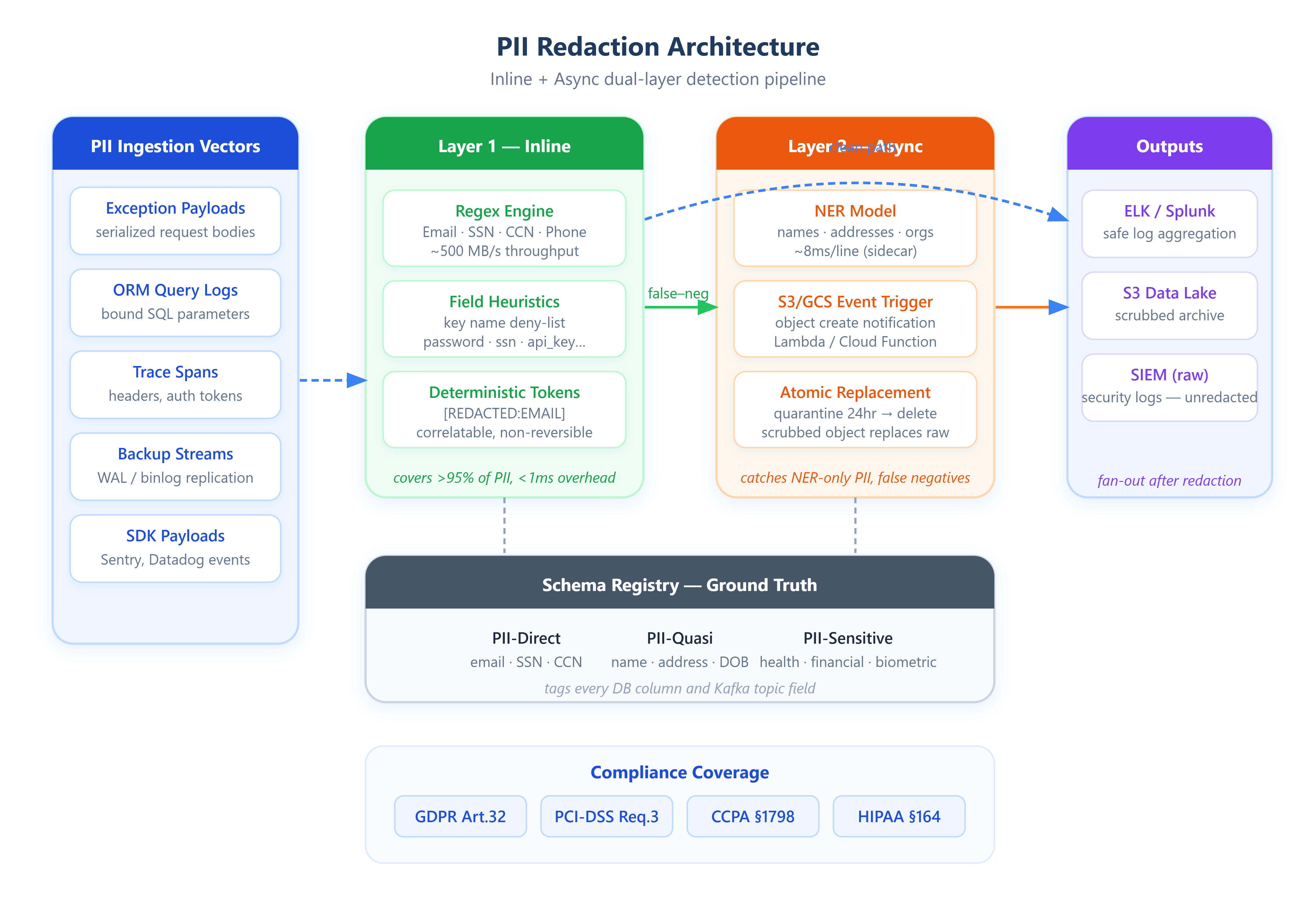
Five primary ingestion vectors drive the majority of PII leakage:
Serialized exception payloads — Stack traces that include request bodies. This is the most common source. An unhandled exception in a payment service dumps the entire deserialized request, which contains cardholder data.
ORM query logging — Hibernate, ActiveRecord, and SQLAlchemy can log full SQL statements including bound parameters. WHERE email = '[email protected]' appears in your slow query log.
Distributed trace spans — OpenTelemetry and Jaeger spans often carry HTTP headers (including Authorization tokens) and request attributes engineers attached for debugging.
Backup streams — Database logical replication logs (WAL in Postgres, binlog in MySQL) capture every row mutation and stream to S3 or GCS, frequently exempted from the scrubbing pipeline that handles application logs.
Third-party SDK payloads — Analytics, error-tracking (Sentry, Datadog), and A/B testing SDKs serialize event contexts that may include user identity fields.