Introduction
A base model is a hypothesis. A fine-tuned model is a product. The gap between those two things isn’t mathematical — it’s operational. Teams that treat fine-tuning as “run a script in a notebook” eventually hit a wall: reproducibility breaks, models regress silently, datasets drift, and nobody can explain which checkpoint shipped to production last Tuesday. Designing a fine-tuning pipeline is fundamentally a distributed systems problem wearing an ML hat.
Core Concept: The Fine-Tuning Pipeline
Fine-tuning adapts a pre-trained foundation model to a specific task by continuing training on a curated domain dataset. The challenge isn’t the gradient math — it’s orchestrating the data, compute, validation, and versioning layers into a system that behaves correctly under failure, scales without bottlenecks, and produces artifacts you can actually trust.
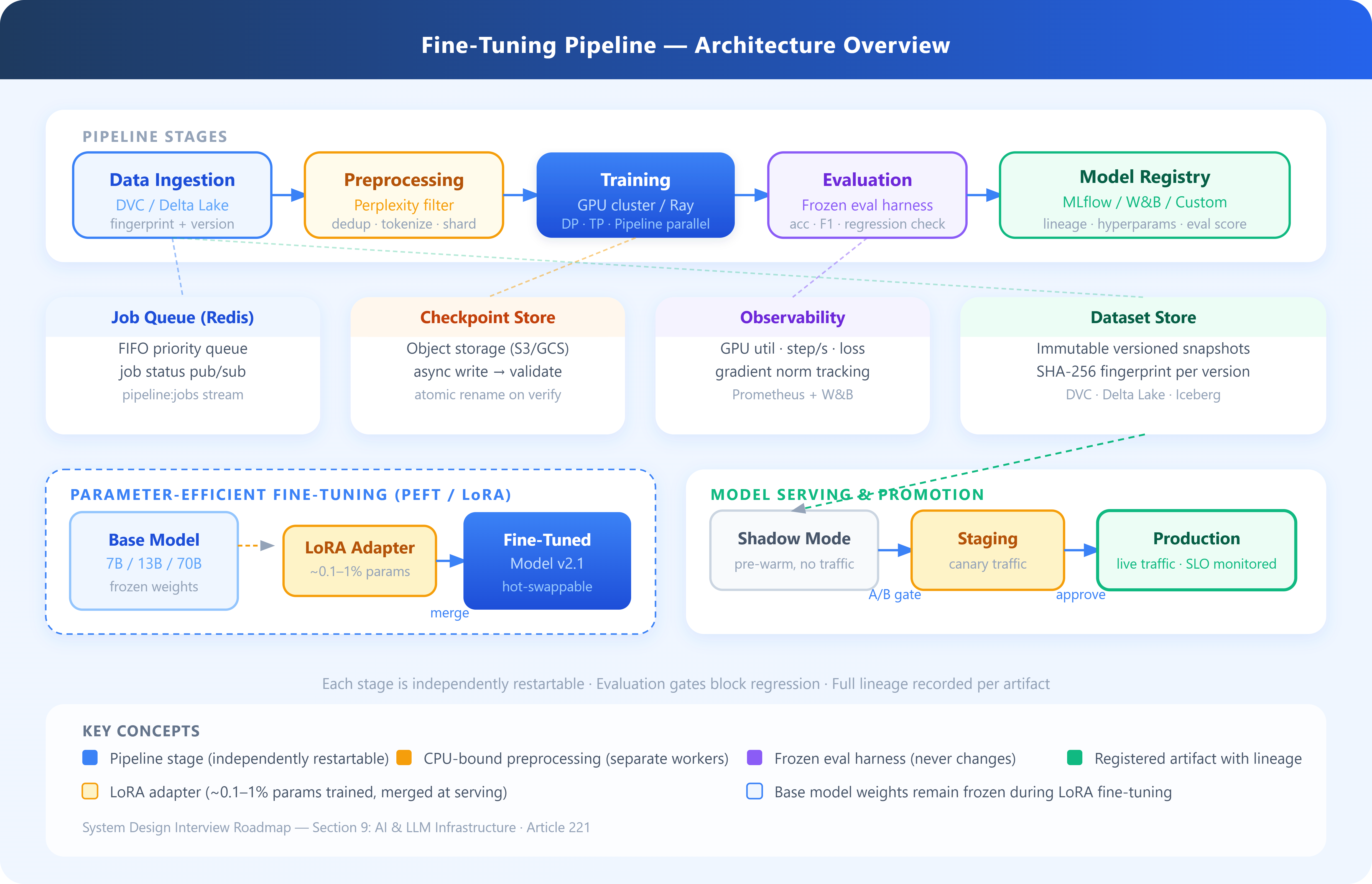
A production fine-tuning pipeline has five distinct stages that must be independently restartable and observable.
Stage 1 — Data Ingestion & Versioning Raw training data arrives from object storage (S3, GCS), annotation pipelines, or RLHF feedback systems. Before anything trains, every dataset version must be fingerprinted. Tools like DVC or Delta Lake provide immutable dataset snapshots. The failure pattern here: teams that skip versioning can’t answer “what data produced this model?” six months later — which kills audit trails and compliance.
Stage 2 — Preprocessing & Tokenization Raw text gets cleaned, filtered for quality (perplexity filtering, dedup via MinHash LSH), and tokenized into packed sequences. This stage runs on CPU-heavy workers (separate from GPU training nodes) and produces binary shard files. A common mistake: running tokenization inside the training loop wastes GPU cycles on CPU-bound work and creates non-deterministic throughput under variable data shapes.
Stage 3 — Training Job Orchestration The training job itself is submitted to a job scheduler (Ray, Slurm, Kubernetes Job API) with explicit resource requests. Key decisions here: gradient checkpointing to trade compute for memory, mixed-precision (bf16/fp16) to reduce VRAM pressure, and gradient accumulation to simulate large batch sizes across limited hardware. For distributed runs, you choose between data parallelism (each node holds the full model), tensor parallelism (model sharded across nodes), or pipeline parallelism (model layers split across stages). Each has distinct failure modes — pipeline parallelism, for instance, introduces pipeline bubbles that reduce GPU utilization.
Stage 4 — Checkpoint Management Training jobs die. GPU nodes preempt. Cloud spot instances evict. Checkpoints must be written to durable storage at regular intervals and the pipeline must resume from the latest valid checkpoint without human intervention. A subtlety: corrupted checkpoints (written during a crash) need detection logic. Write to a temp path, validate, then atomic rename.
Stage 5 — Evaluation, Registry & Promotion After training completes, the model runs against a frozen eval harness — benchmark tasks that don’t change between runs, covering both target task performance and regression tests for general capabilities. Models that pass thresholds get registered in a model registry (MLflow, Weights & Biases Registry, or custom) with full lineage metadata: dataset version, hyperparameters, hardware config, eval scores. Promotion to staging or production requires explicit human approval or automated A/B gate logic.