
Most advice about levelling up from L5 to L6 sounds like this: go broader, go deeper, show more impact, lead across teams.
All of this is true. None of it tells you what to do differently on Tuesday morning.
This post is the concrete version. What L6 actually adds in a system design interview, what experience you need before the interview will show it, and what to do in the next 90 days if you’re targeting L6 and currently at L5.
First: understand what L6 is actually assessing
The L5 interview asks: can you design a system that works?
The L6 interview asks: can you design a system that works, that you could operate at 3 AM when it’s failing, and that a team of 10 engineers could build and maintain without constant guidance from you?
Those are different questions. The first is technical correctness. The second is operational maturity plus organizational awareness. Preparing for L6 without understanding this distinction means you’ll produce an excellent L5 answer and wonder why it didn’t land.
The three things L6 adds in the room
I’ve written about Senior vs Staff breakdowns in the paid walkthroughs, but let me be explicit here about what the additions actually are.
SLOs with monitoring signals. An L5 says “I’d target p99 < 100ms.” An L6 says “I’d target p99 < 100ms, and the signal I’d alert on is cache hit ratio dropping below 90% — that’s the leading indicator that Postgres load is about to spike. By the time the latency exceeds 100ms it’s already a problem, but the cache hit ratio tells me it’s about to be a problem while I still have time to act.”
That addition — the leading indicator, not just the threshold — takes 20 seconds to say and is the clearest operational maturity signal in a system design interview. L5 candidates almost never include it without being asked. L6 candidates include it naturally because they’ve been on-call and learned, usually painfully, that the metric you alert on is not the metric you care about.
The revisit condition. An L5 says “I’d partition by user_id because the hot read pattern is per-user.” An L6 says all of that and then adds: “The failure mode here is hot partitions if one user has disproportionate data volume. I’d monitor partition size variance in the first week and set up automatic re-partitioning if any shard exceeds 3× the average. That number is a starting hypothesis — I’d tune it based on actual data.”
The revisit condition shows that you’ve designed systems that later needed to be changed, and that you build in the instrumentation to know when to change them. This is genuinely hard to fake if you haven’t done it. It’s not a vocabulary signal — it’s an experience signal.
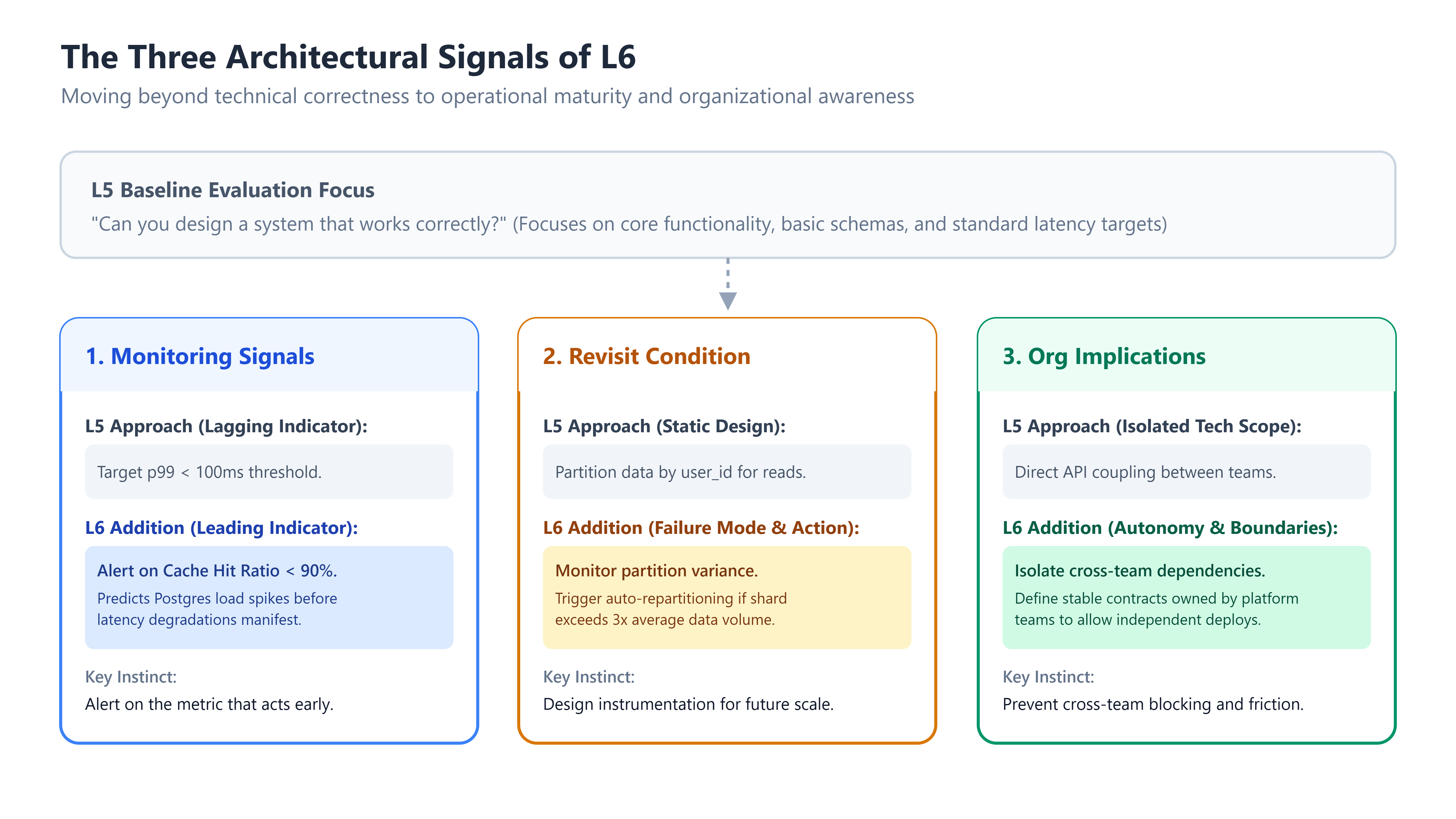
Organizational implications. This is the most L6-specific addition and the one most candidates skip entirely. After designing a payment notification system: “One thing I’d flag: this architecture creates a dependency between the payments team and the notifications team at the API contract level. If the notifications schema changes, payments has to coordinate. I’d define the notification contract as a stable interface owned by a platform team so that each product team can deploy independently.”
This sentence is completely invisible to an L5 candidate because L5 engineers generally work within one team and haven’t felt the cost of cross-team coupling. L6 engineers have — they’ve been the person blocked for two weeks because another team changed a shared interface without warning. That experience makes the organizational implication feel obvious to name.
What experience you need before the interview will show it
Here’s the uncomfortable truth: if you’ve spent your entire L5 tenure as an individual contributor on a single product team, building new features, the L6 interview will be hard regardless of how much you study.
L6 evidence is experiential. The monitoring signal addition requires having been on-call and learned what you actually alert on vs what you care about. The revisit condition requires having designed something that later broke in production and had to be changed. The organizational implication requires having felt the friction of cross-team coupling firsthand.
The 90 days before a targeted L6 loop should not just be interview prep. It should be deliberate experience accumulation:
Get on-call rotation, if you’re not already. Even 4 weeks of on-call for a production service will teach you more about operational maturity than any amount of walkthrough reading. You’ll learn what the leading indicators are, what the lagging indicators are, and what it feels like to have the wrong alert fire at 2 AM. That experience will show in the interview automatically.
Own a cross-team project, however small. Propose a shared API, a platform improvement, or a migration that affects two teams. Go through the coordination overhead. Feel the friction of interface ownership. When the interview asks about organizational implications you’ll have something real to draw on.
Write one design doc that gets scrutinized. Not a quick proposal — a full design doc reviewed by engineers senior to you who push back on your decisions. The experience of defending architectural choices against experienced criticism is directly transferable to the interview room.
The 90-day interview prep plan for L6
Given the above, the split should be different from an L5 prep plan.
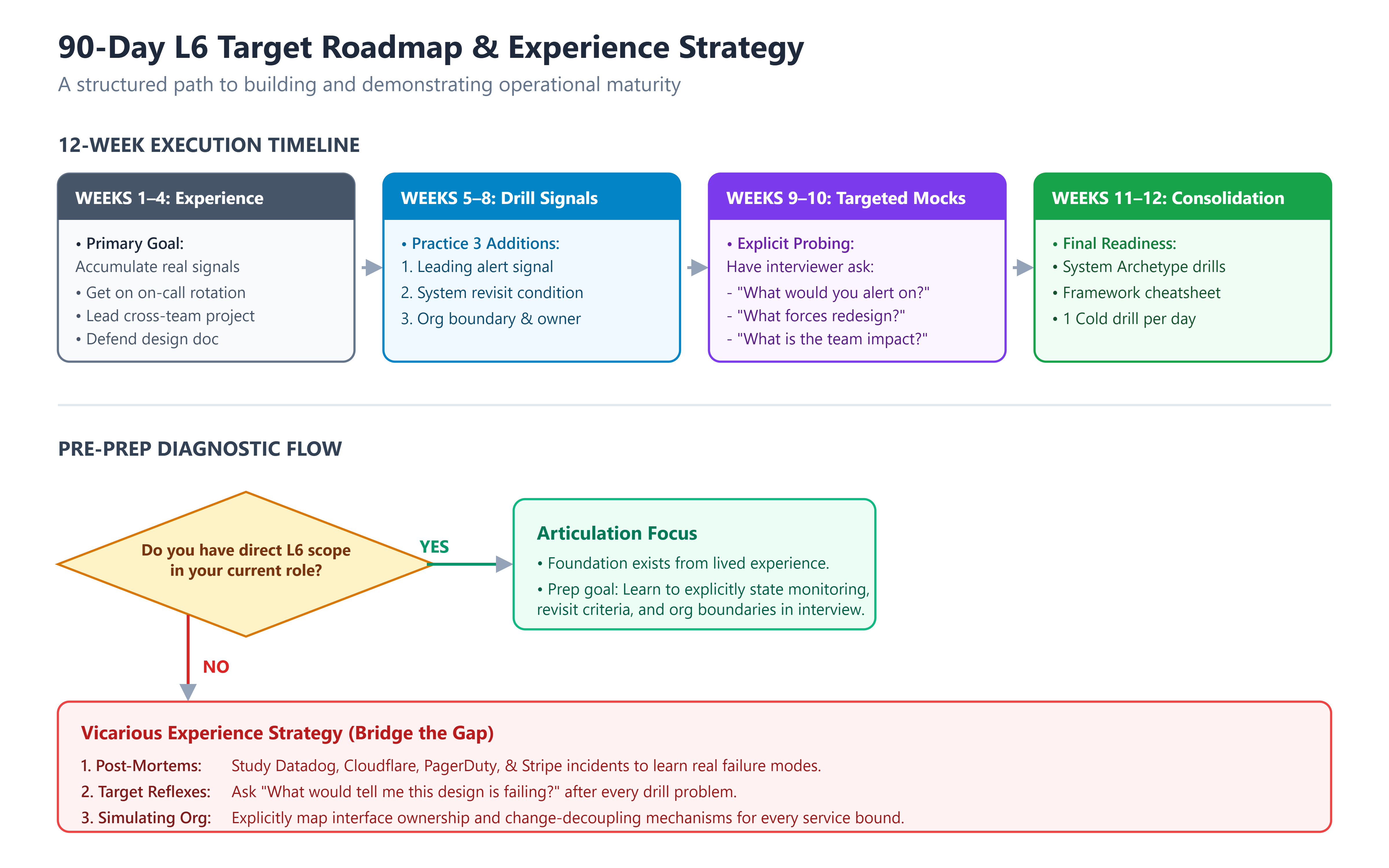
Weeks 1–4: Get the experience if you don’t have it. See above. No amount of interview prep replaces the operational instincts that on-call builds.
Weeks 5–8: Drill specifically on L6 signals. For every question you drill, force yourself to add three things after the architecture: the monitoring signal for the most critical component, the revisit condition for the riskiest design decision, and the organizational implication of the biggest architectural boundary you introduced. These three additions are almost mechanical once you know to look for them.
Weeks 9–10: Two mock interviews. Ask the mock interviewer to specifically probe the L6 signals: “What would you alert on?” “What would make you reconsider this architecture?” “What does this mean for team autonomy?” If you can answer those three probes naturally in a mock, you’ll answer them naturally in the real interview.
Weeks 11–12: Consolidation. Same plan as any loop prep — drill cards, framework cheatsheet, one cold drill per day. Target the archetypes most relevant to your company.
What to do if your current role isn’t giving you L6 experience
Some engineers are targeting L6 at a new company because their current role doesn’t have the scope to build that experience. That’s a legitimate situation and worth being honest about.
The interview prep in that case should lean more heavily on vicarious experience: read incident post-mortems from engineering blogs (Cloudflare, Stripe, Datadog, and PagerDuty all publish detailed post-mortems). Read design documents from open source projects. Follow engineering blogs from companies operating at the scale of your target company.
The monitoring signal and revisit condition habits can be built by asking “what would tell me this design is failing?” after every drill, even if you’ve never been on-call. It’s not the same as lived experience, but it builds the reflex of thinking that way.
The organizational implication is harder to simulate. The closest substitute is: for every architectural boundary you draw in a design (this service vs that service, this team’s responsibility vs that team’s), explicitly name who owns the interface, what happens if either side changes it, and whether there’s a better way to isolate the two.
The question worth asking yourself
Before you start interview prep, sit with this for a few minutes: in the last six months, have you made architectural decisions that affected engineers outside your immediate team? Have you been woken up at 2 AM by a broken system and had to diagnose it? Have you owned an interface that another team depended on?
If yes to two or three: you probably have the experiential foundation and the interview prep is about learning to articulate it explicitly.
If no: the 90 days before your loop are more valuable spent accumulating those experiences than reading walkthroughs. The interview is a test of whether you think like an L6 engineer. That thinking comes from doing L6-level work, even briefly, more than from any amount of preparation.
The walkthroughs tell you what to say. The experience gives you something true to say.
CTA: The Senior vs Staff section in every paid walkthrough breaks down exactly what L6 adds for that specific question — not in the abstract, but with the exact phrases and decisions that separate Hire from Strong Hire at that level.
If you found this valuable, the full content library includes bonus lessons, exercises, and detailed breakdowns.
https://systemdr.systemdrd.com/subscribe
—Sumedh
The Question Vault has all 52 walkthroughs organized by archetype — so you can see the pattern across questions, not just the surface answer.
Access all 52 Questions here