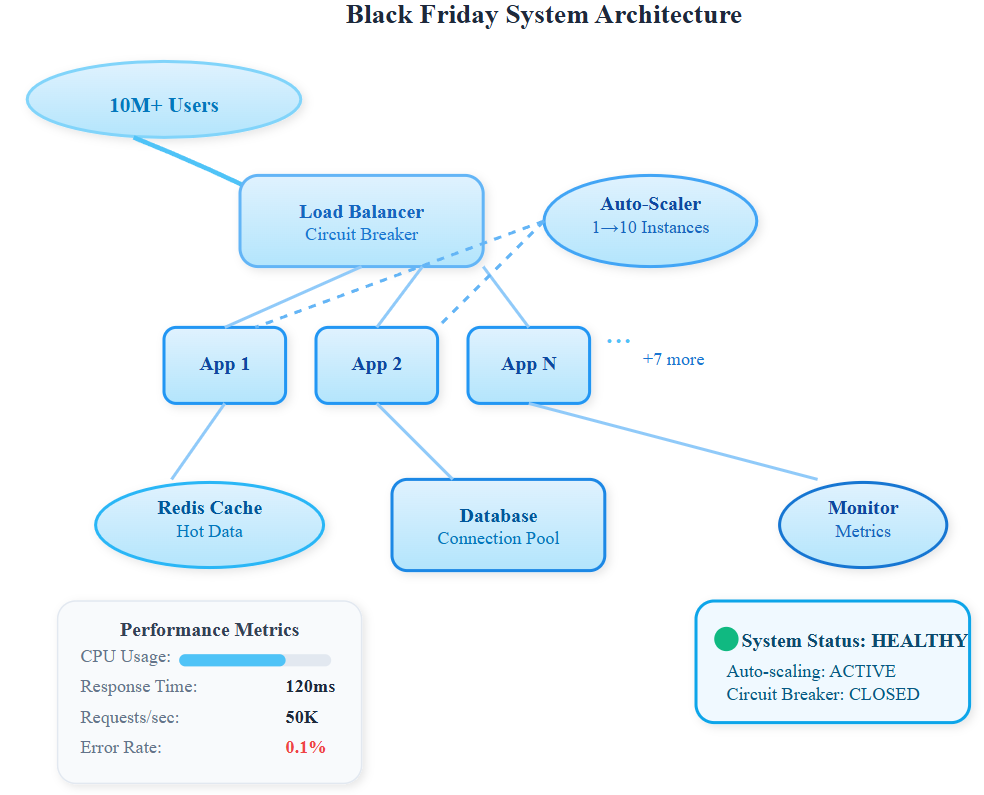
When 10 Million Users Hit "Buy Now" Simultaneously
At 12:00 AM EST on Black Friday 2019, Target's website went dark for 90 minutes. Not from a cyberattack or infrastructure failure, but from something far more predictable—their own success. Millions of eager shoppers created a perfect storm that exposed every weakness in their load preparation strategy.
This isn't about having "enough servers." It's about architecting systems that gracefully handle 100x traffic spikes while maintaining sub-second response times and zero data corruption.
What You'll Master Today
Predictive Load Modeling: Calculate exact capacity needs before the storm hits
Progressive Scaling Patterns: Auto-scale without creating cascading failures
Circuit Breaker Orchestration: Protect critical services during traffic tsunamis
Real-time Load Distribution: Route traffic intelligently across healthy nodes
Graceful Degradation: Maintain core functionality when components fail
Youtube Video:
The Anatomy of Extreme Load Events
Black Friday isn't just "more traffic"—it's a fundamentally different usage pattern that breaks normal assumptions.
Traffic Spike Characteristics
Regular e-commerce traffic follows predictable patterns. Black Friday creates synchronized demand spikes where millions of users perform identical actions within seconds. This creates three critical challenges:
Hot Spot Formation: Popular items create database hot spots as thousands compete for the same inventory records. Traditional sharding breaks down when 80% of requests target 5% of products.
Cache Invalidation Storms: Inventory updates trigger massive cache invalidations. Redis clusters can become bottlenecks when every node needs to evict the same product keys simultaneously.
Connection Pool Exhaustion: Database connection pools sized for normal load become insufficient. Connection establishment overhead creates latency spikes that cascade through dependent services.