
Learn System Design with System building, Subscribe Hands On coding course - LogStream
Most engineers preparing for senior-level interviews have a vague sense that “L6 answers go deeper.” This is both true and useless as preparation advice. Deeper in what direction? Deeper by how much? What specifically changes?
refer basics here - load balancing 101 -
Here is what specifically changes.
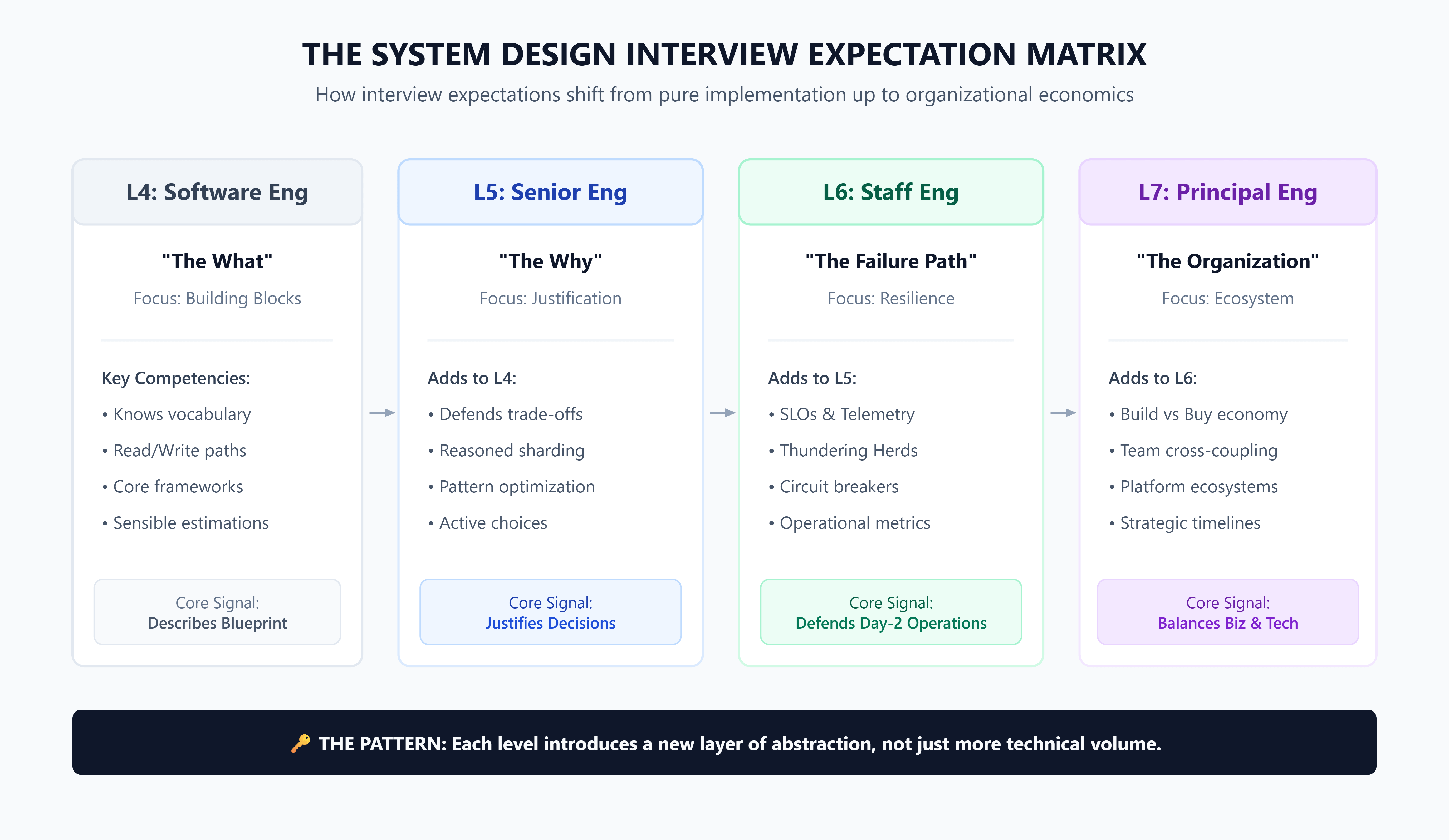
L4 → L5: from “what” to “why”
An L4 answer describes the architecture. An L5 answer defends it.
At L4, the bar is: can you run a framework, estimate sensibly, and produce a coherent design with read and write paths? That’s it. Interviewers are checking whether you know the building blocks.
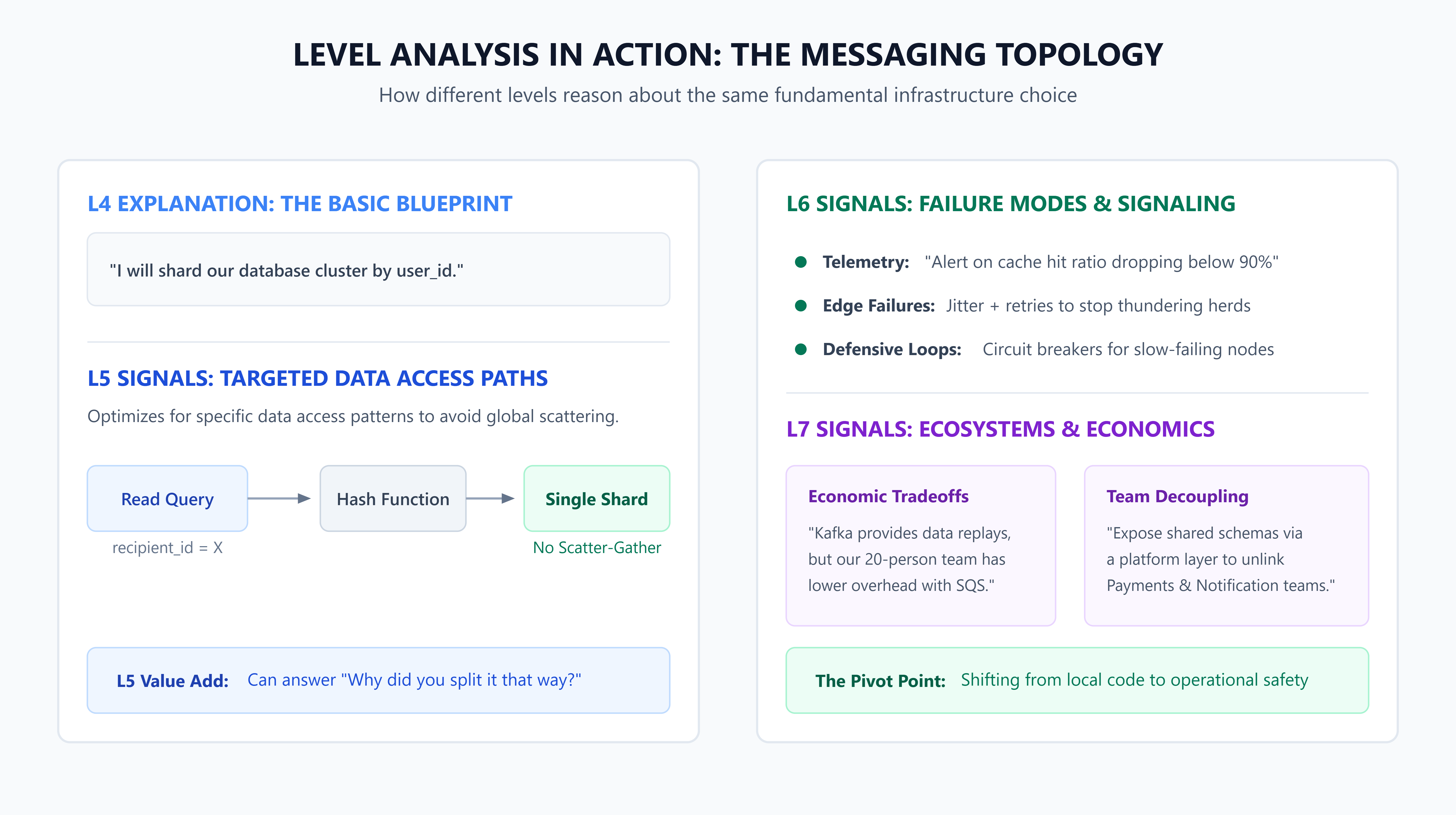
At L5, the bar is: can you justify your decisions? When the interviewer asks “why did you partition by recipient_id instead of sender_id?”, the L4 candidate says “that’s the standard approach.” The L5 candidate says “because the hot query is ‘give me all pending messages for user X’ — partitioning on the read pattern means that query hits one shard. If I partitioned by sender, delivering to user X requires querying every node.”
The transition from L4 to L5 is the transition from “stating decisions” to “reasoning about decisions.” Same architecture. Different explanation.
L5 → L6: from design to operation
An L5 answer designs a system that works. An L6 answer designs a system that works and describes how you’d know if it was failing.
L6 adds three things that L5 almost never has:
SLOs with monitoring signals. Not “the API should be fast.” “I’m targeting p99 < 100ms for the feed read. The metric I’d alert on is cache hit ratio dropping below 90% — that’s the leading indicator that Postgres load is about to spike.”
Failure modes named and partially addressed. Not “we’d add monitoring.” “The failure mode here is the thundering herd when the Redis node recovers — if we don’t add jitter to the retry, every failed request retries simultaneously and we bring Redis down again the moment it comes back up.”
The operational reality of trade-offs. L5 says “consistent hashing handles node failure gracefully.” L6 says “consistent hashing with virtual nodes handles it, but I’d still want an active health check every 5 seconds and a circuit breaker so that if a node is responding slowly rather than failing hard, we stop routing to it before the tail latency affects users.”
The transition from L5 to L6 is the transition from “designing for the happy path” to “designing for the failure path.”
L6 → L7: from system to organization
L7 is the level where the interview stops being about a single system and starts being about the relationship between systems — and the teams that build them.
L7 adds:
Build vs buy decisions with economic reasoning. Not “we’d use Kafka.” “For this use case, Kafka is the right call — the producers and consumers have different scale characteristics and we want replay capability. But if we’re a 20-person company, the operational overhead of Kafka is probably not worth it; I’d use SQS and revisit when the team can support it.”
Organizational implications. “This architecture creates a hard dependency between the payments team and the notifications team. I’d extract the notification contract into a shared schema owned by a platform team to prevent that coupling from slowing down both teams’ deploy cadence.”
Platform thinking. Not “how do I build this feature” but “how do I build this such that 10 teams can build features on top of it without coordinating with me.”
The pattern
Each level adds a type of thinking, not just more of the same thinking.
L4: knows the vocabulary. L5: can reason about trade-offs. L6: thinks about failure, operations, and monitoring. L7: thinks about organizations, economics, and platforms.
If you’re targeting L5, make sure you can answer “why did you make that choice?” for every major decision. That’s the bar.
If you’re targeting L6, make sure every design decision has three parts: what you chose, why you chose it, and what would change your mind.
If you’re targeting L7, make sure you can talk about one decision in terms of its organizational and economic implications — not just its technical ones.
Paid subscribers get a full system design walkthrough every Tuesday.
This week: Stripe Payments — the idempotency key problem most engineers miss.
The paid posts go deeper on the Senior vs Staff distinction for each specific question — here’s what the L5 answer looks like, here’s what L6 adds, here’s the exact phrasing that signals each.
Subscription link
https://systemdr.systemdrd.com/subscribe
—Sumedh
Want the complete learning path?
Unlock advanced modules, case studies, and guided exercises.
The Question Vault has all 52 walkthroughs organized by archetype — so you can see the pattern across questions, not just the surface answer.
Access all 52 Quesstions here