
Message Queues Explained with Café Analogies
Checkout our “System Design Roadmap Course”, Trusted by 32000+ Engineers.
Picture the morning rush at your favourite café. Customers stream in, baristas work frantically, and somehow everyone (eventually) gets their coffee. This organized chaos perfectly illustrates how message queues function in modern software systems.
What Is a Message Queue?
A message queue is a communication mechanism that allows different parts of a software system to exchange messages asynchronously. Like a café's order system, it creates a buffer between the components that produce information (producers) and those that consume it (consumers).
Basic Message Queue Flow
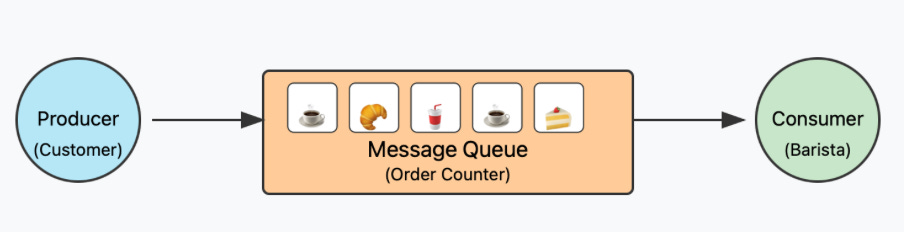
The Café Analogy
Imagine a busy café with these key components:
Customers (Producers) - They place orders at varying rates and times
Order Counter (Message Queue) - Where orders wait to be processed
Baristas (Consumers) - They prepare drinks when they're available
In this scenario:
Orders (messages) are placed regardless of how busy the baristas are
The counter (queue) holds orders in the sequence they were received
Baristas (consumers) process orders at their own pace without rushing
Core Benefits of Message Queues
1. Decoupling
Just as customers don't need to wait for baristas to be free before ordering, producers can send messages without worrying about consumer availability. This independence creates robust systems where components can evolve separately.
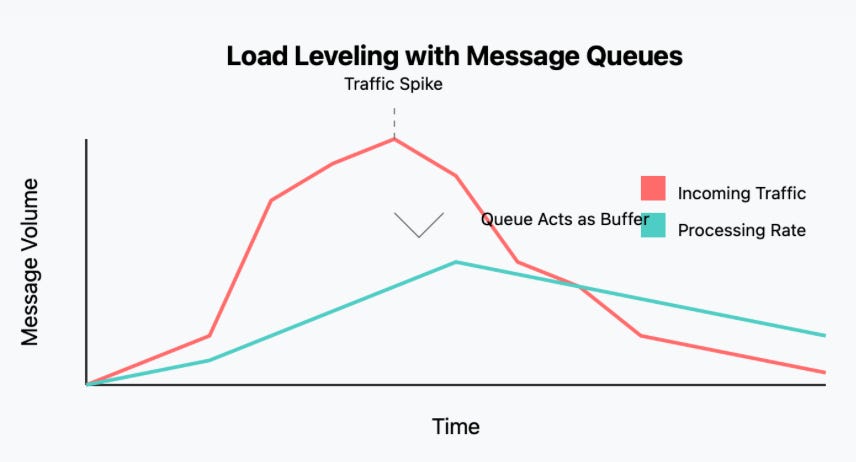
2. Load Leveling
During morning rush hour, the café counter accumulates orders while baristas work steadily. Similarly, message queues absorb traffic spikes, preventing system overload during peak times.
Load Leveling Visualization
3. Reliability
If a barista takes a break, orders don't disappear—they wait on the counter. Similarly, if a consumer service fails, messages remain safely in the queue until processing can resume.
4. Scalability
During rush hour, the café might add more baristas. Likewise, multiple consumer instances can process messages from the same queue, distributing workload dynamically.
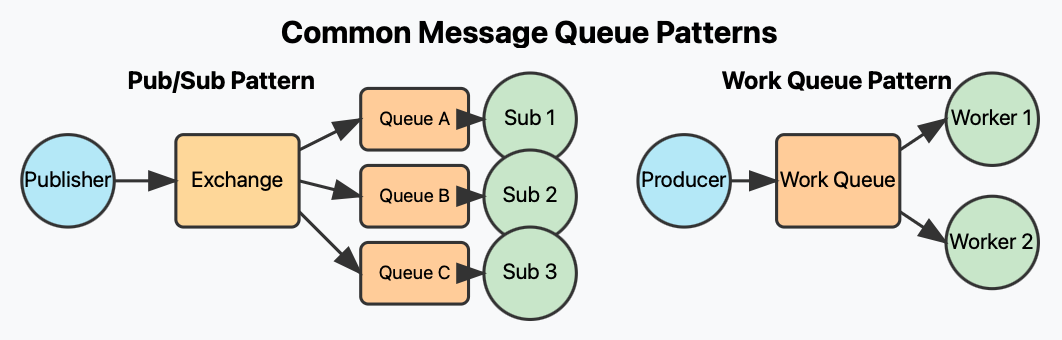
Message Queue Patterns
Pub/Sub (Publication/Subscription)
Like a café's intercom system where multiple baristas hear "Order up!" announcements, pub/sub allows one message to reach multiple consumers.
Work Queues
Similar to specialized baristas (one for espresso, another for pastries), work queues distribute tasks among different worker services based on their specialties.
Message Queue Patterns
Real-World Applications
E-commerce Order Processing
When you click "Buy Now," your order enters a queue. Even if payment processing is slow or inventory systems are busy, your order waits safely in line without causing the website to freeze.
IoT Data Collection
Smart devices (like weather sensors) generate data constantly. Message queues collect these readings, ensuring no data is lost even when processing systems are overwhelmed.
Microservice Communication
In large applications with dozens of separate services, message queues enable reliable communication between components that operate at different speeds or availability levels.
Popular Message Queue Technologies
RabbitMQ - Feature-rich, general-purpose message broker supporting multiple protocols
Apache Kafka - High-throughput distributed streaming platform, ideal for event streams
Amazon SQS - Fully managed queue service with guaranteed delivery
Redis Streams - In-memory data structure providing queue-like functionality with high performance
Implementing Basic Message Queuing
Think of implementing a message queue like setting up the café's order system:
Design your messages - Like order tickets with clear information
Configure durability settings - Will messages persist if the system restarts?
Set up retry policies - How to handle failed processing attempts
Implement poison message handling - What happens with problematic orders
Conclusion
Message queues transform chaotic interactions into organized flows, just like a well-run café turns the morning coffee rush into a smooth, efficient process. By buffering communication between components, they create systems that are more reliable, scalable, and resilient.
Whether you're building a small application or an enterprise system handling millions of operations, understanding queue-based architectures will help you design solutions that gracefully handle real-world conditions.