
The Silent Protocol War in Your Smart Home
Your smart thermostat just received a temperature update. In the 47 milliseconds it took to process that message, a critical decision was made—not by you, but by the protocol designer who chose between MQTT’s persistent connections and CoAP’s stateless requests. That choice determines whether your home automation survives a network hiccup or leaves you shivering in the dark.
Two Philosophies, One Mission
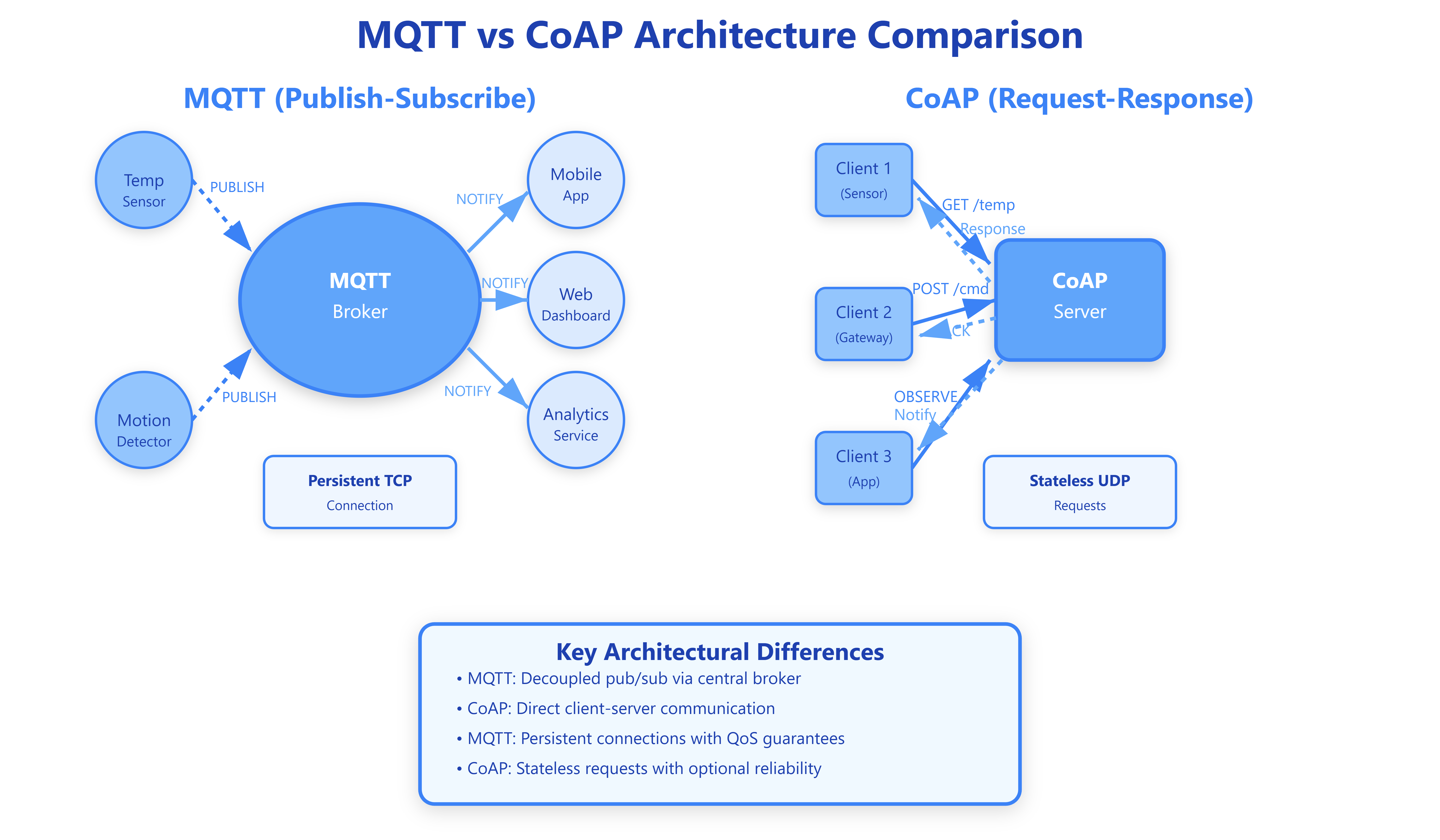
MQTT and CoAP both solve the IoT communication problem, but they’re fundamentally different animals. MQTT operates like a newsroom—publishers broadcast to topics, subscribers listen to what interests them, and a central broker routes everything. CoAP works like HTTP’s minimalist cousin—devices make direct requests, get responses, and move on.
MQTT maintains persistent TCP connections with Quality of Service guarantees. When a sensor publishes temperature data to the “home/living-room/temp” topic, the broker ensures every subscriber receives it, even storing messages for offline devices. This pub-sub model decouples senders from receivers—your thermostat doesn’t need to know which devices care about temperature, it just publishes.
CoAP takes the opposite approach. Built on UDP, it uses a request-response model similar to HTTP but optimized for constrained devices. A CoAP client sends a GET request to “coap://sensor.local/temperature” and receives a response. No broker, no persistent connection, no subscription state. It’s lightweight by design—the entire protocol stack fits in 10KB of RAM.
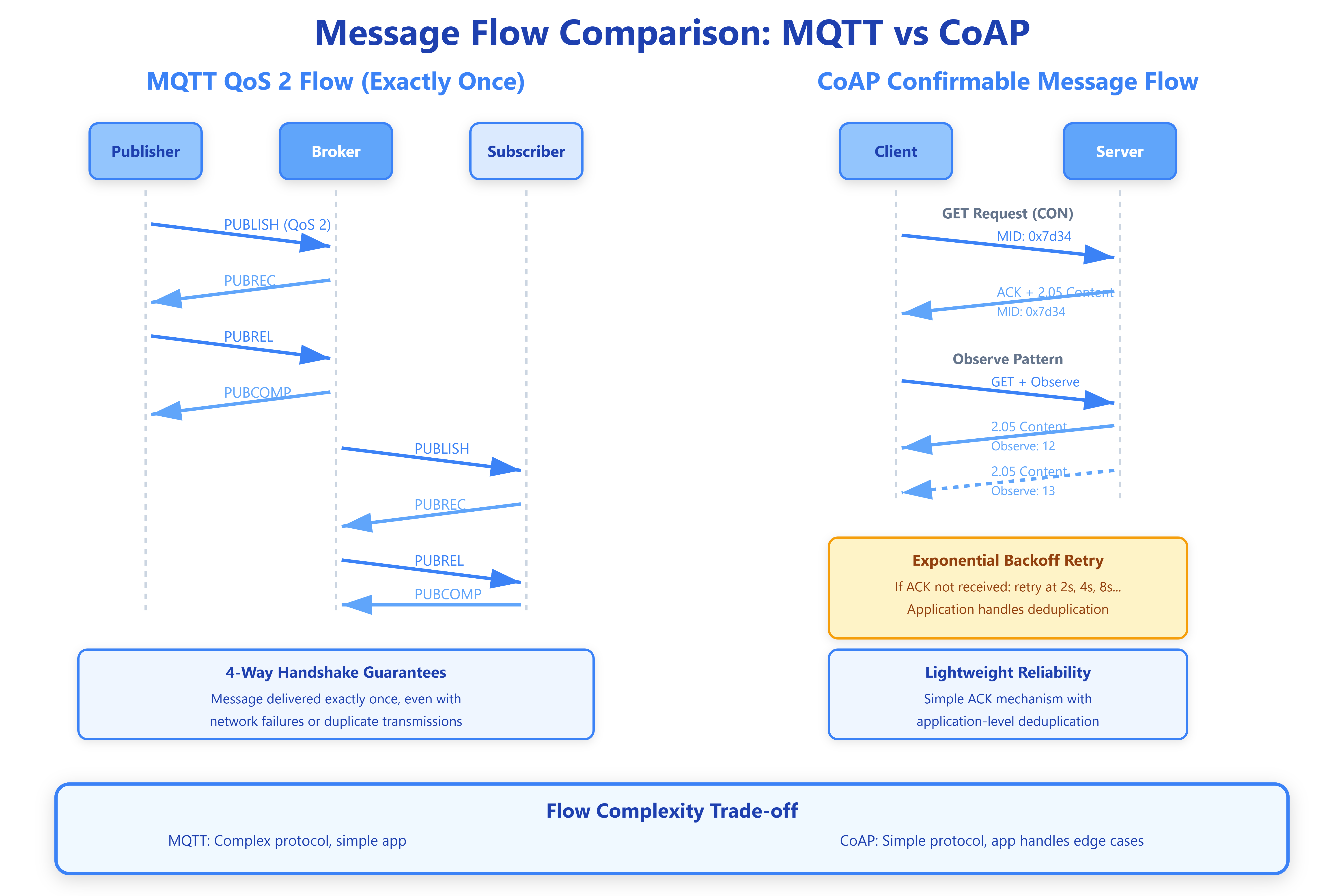
The real magic happens in how they handle network reality. MQTT’s QoS levels (0, 1, 2) provide explicit reliability guarantees. QoS 2 ensures exactly-once delivery through a four-way handshake, critical for billing systems or medical devices. CoAP achieves reliability differently—through confirmable messages with exponential backoff retries, similar to UDP-based protocols. It’s simpler but requires application-level deduplication.
Here’s what breaks at scale: MQTT brokers become single points of failure and bottlenecks. When one broker handles 100,000 connected devices, each publishing at 1Hz, you’re routing 100,000 messages per second through a single process. Clustered brokers solve this but introduce distributed state synchronization—topics must be consistent across brokers, subscriptions must be routed correctly. Netflix discovered this when scaling their IoT telemetry; they ended up with a hybrid approach using MQTT for edge devices but Kafka for inter-datacenter communication.
Critical Insights
Common Knowledge: MQTT uses more bandwidth per message due to TCP overhead and keep-alive packets. CoAP messages are smaller (4-byte header vs MQTT’s variable header plus TCP/IP overhead). For battery-powered sensors sending data once per hour, CoAP’s stateless model dramatically extends battery life.
Rare Knowledge: MQTT’s QoS guarantees break down with broker failover. When a broker crashes mid-flight with QoS 2 messages, the exactly-once guarantee depends on message persistence. If in-flight messages weren’t persisted to disk, subscribers might receive duplicates from republishing clients. Amazon IoT Core handles this by persisting all QoS 1+ messages to DynamoDB before acknowledgment, trading latency for durability.
Advanced Insight: CoAP’s observe pattern creates a hybrid pub-sub model without brokers. A client sends a GET request with the Observe option, and the server streams updates whenever the resource changes. This combines CoAP’s simplicity with MQTT-like push semantics, but creates a hidden state management problem—servers must track observers and handle network churn. Google’s Thread protocol uses CoAP observe for mesh network routing updates, carefully managing observer lists to prevent memory exhaustion.
The Bandwidth Paradox: MQTT appears wasteful with persistent connections, but at high message rates, it’s more efficient. Sending 100 messages over one MQTT connection uses less total bandwidth than 100 separate CoAP requests (each requiring UDP/IP headers and DTLS handshakes). The crossover point is around 1 message per minute—below that, CoAP wins; above that, MQTT wins.
Network Adaptation: CoAP’s blockwise transfer allows transmitting large payloads over constrained networks by fragmenting at the application layer. This is crucial for firmware updates over lossy networks where TCP’s congestion control is too aggressive. Philips Hue uses this for over-the-air updates, fragmenting 1MB firmware images into 1KB blocks.
Security Reality: Both protocols support encryption (MQTT over TLS, CoAP with DTLS), but the operational reality differs. DTLS handshakes consume significant power—a problem for battery devices. Pre-shared keys help but require secure provisioning. MQTT’s persistent connection amortizes the TLS handshake cost across thousands of messages, while CoAP devices often skip encryption entirely for local networks, relying on network-layer security instead.
Real-World Implementations
GitHub Link
https://github.com/sysdr/sdir/tree/main/MQTT_vs_CoAP/mqtt-coap-demoAWS IoT Core processes 13 billion MQTT messages daily, handling device shadows—virtual representations of device state that survive disconnections. When a smart lock goes offline, applications read its shadow for last-known state. AWS implemented custom MQTT extensions for this, storing shadows in DynamoDB with eventually-consistent replication across regions.
Meta uses CoAP for internal datacenter hardware monitoring where devices report metrics to centralized collectors. The stateless model simplifies load balancing—any collector can handle any request without session affinity. They batch CoAP responses using multicast to reduce network traffic, aggregating metrics from 10,000 servers into 100 multicast groups.
Azure IoT Hub supports both protocols but routes MQTT messages through Event Hubs for stream processing. The platform translates MQTT topics into Event Hub partitions, enabling parallel processing of device telemetry while maintaining per-device ordering. They learned that MQTT broker scaling requires careful topic design—wildcard subscriptions to “sensors/+/temperature” across 1 million devices can overwhelm brokers with subscription matching overhead.
Architectural Considerations
Choose MQTT when you need reliable delivery, complex routing patterns, or want to decouple producers from consumers. The broker architecture enables sophisticated filtering and routing but requires operational investment in broker clustering, monitoring, and capacity planning. Monitor broker queue depths and connection counts—when queues back up, you’re either under-provisioned or have slow consumers creating backpressure.
Choose CoAP for battery-constrained devices, simple request-response patterns, or multicast scenarios. The absence of broker infrastructure reduces operational complexity but pushes state management to applications. CoAP shines in local networks (home automation, industrial sensors) where low latency and minimal overhead outweigh sophisticated routing.
Hybrid approaches often work best. Use CoAP for local device-to-gateway communication and MQTT for gateway-to-cloud. This combines CoAP’s efficiency at the edge with MQTT’s reliable cloud ingestion. SmartThings hubs use exactly this pattern, running CoAP locally for Zigbee devices while maintaining an MQTT connection to the cloud.
Run It Yourself
Execute bash setup.sh to launch a live comparison environment. You’ll see two identical smart home scenarios—one using MQTT, one using CoAP. Simulate network failures, observe message delivery patterns, and compare resource consumption. The demo includes realistic device behaviors: temperature sensors publishing readings, motion detectors sending events, and actuators responding to commands.
Watch how MQTT maintains subscriptions through broker restarts while CoAP clients must re-establish observe relationships. Monitor the network tab to see MQTT’s keep-alive overhead versus CoAP’s per-request efficiency. Try scaling to 100 virtual devices—you’ll see MQTT’s broker CPU spike with subscription matching while CoAP collectors remain nearly idle.
The choice between MQTT and CoAP isn’t about which is “better”—it’s about understanding the trade-offs. MQTT trades resource overhead for reliability and decoupling. CoAP trades features for simplicity and efficiency. Master both, and you’ll architect IoT systems that handle millions of devices while surviving the network chaos of the real world.
Solid technical breakdown. The MQTT vs CoAP choice is one of the most consequential decisions in IoT architecture, and you've mapped the tradeoffs well. I'd add one dimension that's increasingly critical: how Edge AI changes the protocol calculus entirely.
We're moving from the "Internet of Things" -- where devices just ship raw telemetry to the cloud -- to what I call the "Internet of Smart Things," AKA Edge AI. In this new paradigm, devices run inference locally and only transmit actionable insights upstream. That fundamentally changes the protocol requirements.
When a camera runs object detection at the edge instead of streaming video, your message payload drops from megabytes to bytes -- just metadata like "person detected, zone 3, confidence 0.94." At that point, CoAP's lightweight footprint becomes even more compelling for battery-constrained edge devices. The bandwidth paradox you describe (MQTT wins above 1 msg/min) shifts dramatically when Edge AI reduces message frequency by 100x because you're only sending events, not data.
The hybrid approach you mention (CoAP local, MQTT cloud) is exactly the right pattern for the Internet of Smart Things. Edge AI inference happens locally over CoAP, and only the distilled intelligence gets pushed to the cloud over MQTT. That's the architecture that scales to billions of smart devices without drowning in data.