
Learn System Design with System building, Subscribe Hands On coding course - LogStream
Every few weeks, someone posts in the Discord’s #offers-landed channel. L5 at Google. Senior at Stripe. Staff at DoorDash. L6 at Meta after two prior failed loops.
I read every one. After enough of them, patterns become visible. The engineers who pass consistently are not uniformly technically stronger than the ones who fail. They are systematically different in three specific ways.
They scope, then go deep. Not the other way around.
The most common failure mode I hear in post-mortems from engineers who got “No Hire” is some version of: “I designed a great system but ran out of time before the hard part.”
Every engineer who has passed at L5 or above in the last six months has told me some version of the same thing: they spent the first five minutes explicitly scoping — “I’m going to focus on the timeline and the fan-out architecture, and I’m going to acknowledge but not design the notifications, search, and ads” — and then went deep on the one component they chose.
The engineers who fail design everything shallowly. The engineers who pass design one thing deeply.
This is not a trivial shift. Most engineers feel obligated to cover everything. The pressure to show breadth is real. Resisting it and committing to depth in the first five minutes is a deliberate choice that requires practice.
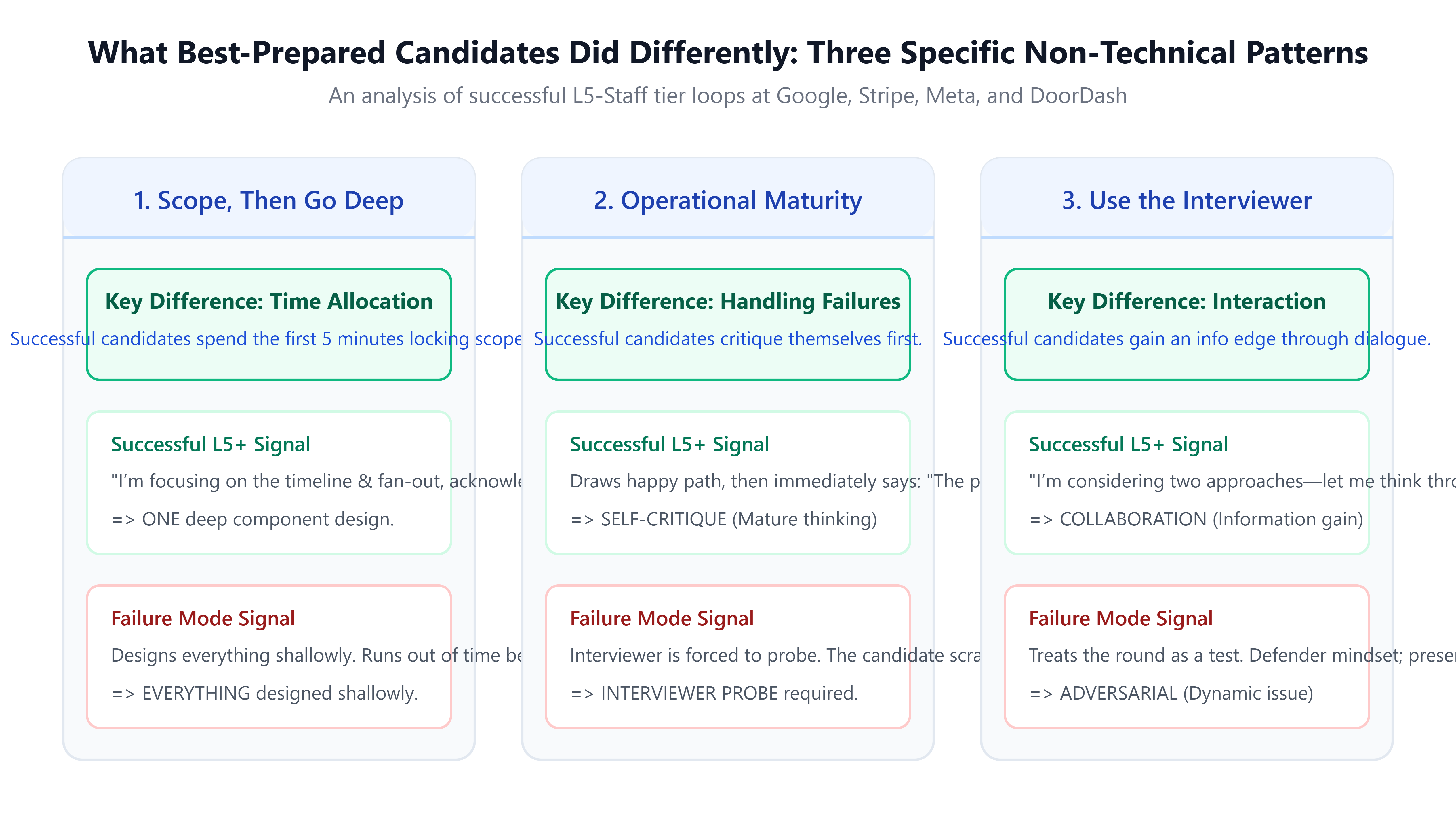
They say the hard thing out loud before the interviewer asks.
The standard pattern in a design interview is: candidate draws the happy path, interviewer probes the failure case, candidate scrambles to address it.
The pattern in successful candidates is different: candidate draws the happy path, then immediately says “the part of this design I’m most concerned about is the thundering herd when the cache node recovers — let me address that.” The probe never comes because the candidate already went there.
This signals something important: not just that you know the failure mode, but that you think about your own designs critically. That’s the operational maturity signal. It’s very hard to fake, and it’s very clear when it’s present.
They treat the interviewer as a collaborator, not an examiner.
This one is harder to describe but unmistakable when you see it.
Candidates who fail tend to treat the design round as a test — something being administered to them. They present, the interviewer asks, they defend. The dynamic is adversarial even when the interviewer is trying to be helpful.
Candidates who pass tend to use the interviewer. “I’m considering two approaches here — let me think through both with you.” “Does this constraint change which way you’d go?” “I’m not sure which way this scales better — what’s your intuition?”
This works for two reasons. First, it makes the interview feel collaborative, which influences the interviewer’s overall impression. Second, and more importantly, it gets you real information. When you say “I’m torn between these two approaches” and the interviewer says “let’s explore the second one,” they’ve just told you where the interesting part of the question is. That’s not cheating — that’s good communication.
What these three things have in common
None of them are technical. Scoping, self-critique, and collaboration are all communication skills. They’re skills you can practice in a mock interview. You cannot practice them by reading another walkthrough.
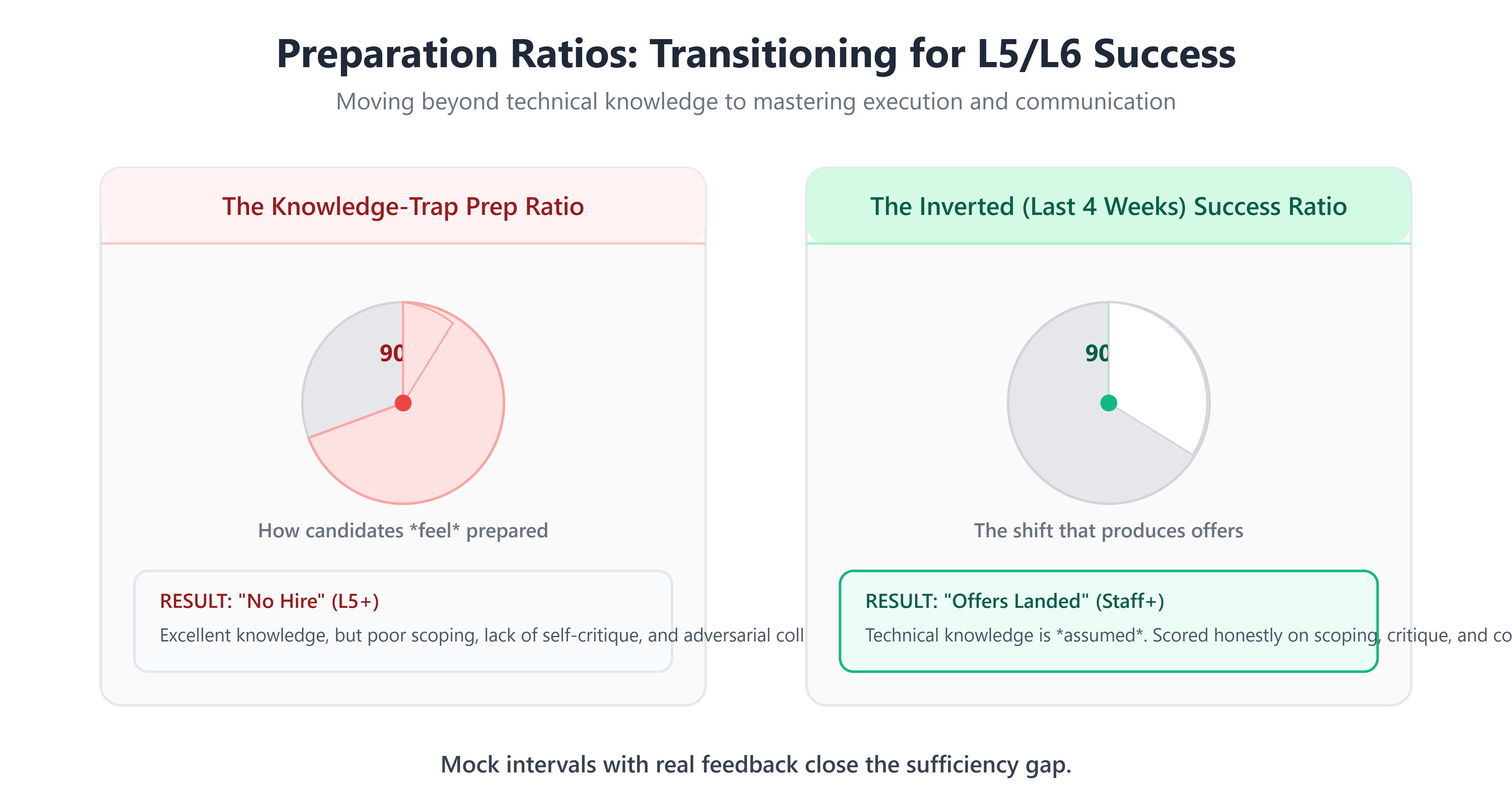
The most common mistake I see in prep is the ratio: 90% reading walkthroughs, 10% timed drills with feedback. The engineers who pass consistently tend to invert that ratio in the final 4 weeks before the interview.
The knowledge is necessary. It’s just not sufficient.
If you’ve been reading this newsletter and feel solid on the technical content, the thing to do next is not to read more. It’s to schedule a mock with someone who will score you honestly on scoping, critique, and collaboration — not just on whether you knew consistent hashing.
CTA:
Paid subscribers get one full system design walkthrough
every Tuesday — each mapped to its archetype so you build
pattern recognition, not answer memorization.
This week: Rate Limiter.
Subscription link
https://systemdr.systemdrd.com/subscribe
—Sumedh
Curious how this works in real systems?
The paid lessons cover scalability, optimization, and real-world engineering patterns.