
The system design interview is a conversation, not a presentation. The interviewer is giving you signals throughout the session. Most candidates miss them because they’re heads-down in their own design, narrating as they go, not watching the person on the other side of the table.
Here’s what those signals look like and what to do with each one.
Signals that you’re on track
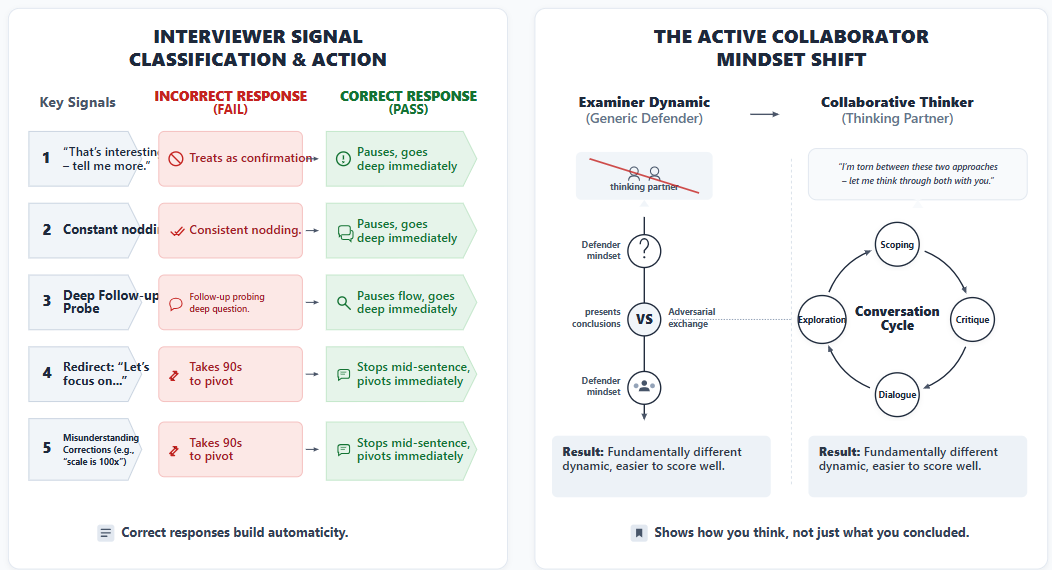
“That’s interesting — tell me more about that.”
This is the best signal you can receive. The interviewer is engaged, they want to go deeper on something you said, and they’re inviting you to. Do it immediately. Whatever you were about to say next, pause it. Go deeper on the thing they asked about.
The mistake: treating this as confirmation that everything is fine and continuing your prepared flow. The interviewer told you where the interesting part of the question is. Follow them there.
Consistent nodding during a long explanation means you’re not losing them. Keep the same pace and depth.
A follow-up question that goes one level deeper on something you said — not redirecting to a new topic, but drilling into something you introduced — means the interviewer found your point substantive. This is different from a question that redirects you elsewhere
Signals that you need to change direction
“Let’s skip ahead to...” or “Actually, let’s focus on...”
The interviewer is redirecting you. This is not a signal that you did something wrong. It’s information: you’ve covered the previous section sufficiently, or you’re spending time on something that isn’t the probe they care about, or they have a specific component they want to evaluate and they’re efficiently navigating you there.
The correct response: stop mid-sentence if necessary. Don’t finish the paragraph. Say “Sure” and immediately go to where they’re pointing.
The wrong response: finishing your current point before the redirect. Taking 90 seconds to wrap up before pivoting. Explaining why you were going in the direction you were before changing direction.
None of these explanations are useful to the interviewer. The redirect supersedes everything else. Follow it immediately.
“What are the trade-offs?” immediately after you make a decision means: you stated the decision without justifying it. This is a probe, not a compliment. Answer it: what did you choose, what are you giving up, and what would change your mind.
Signals that you’ve misunderstood the question
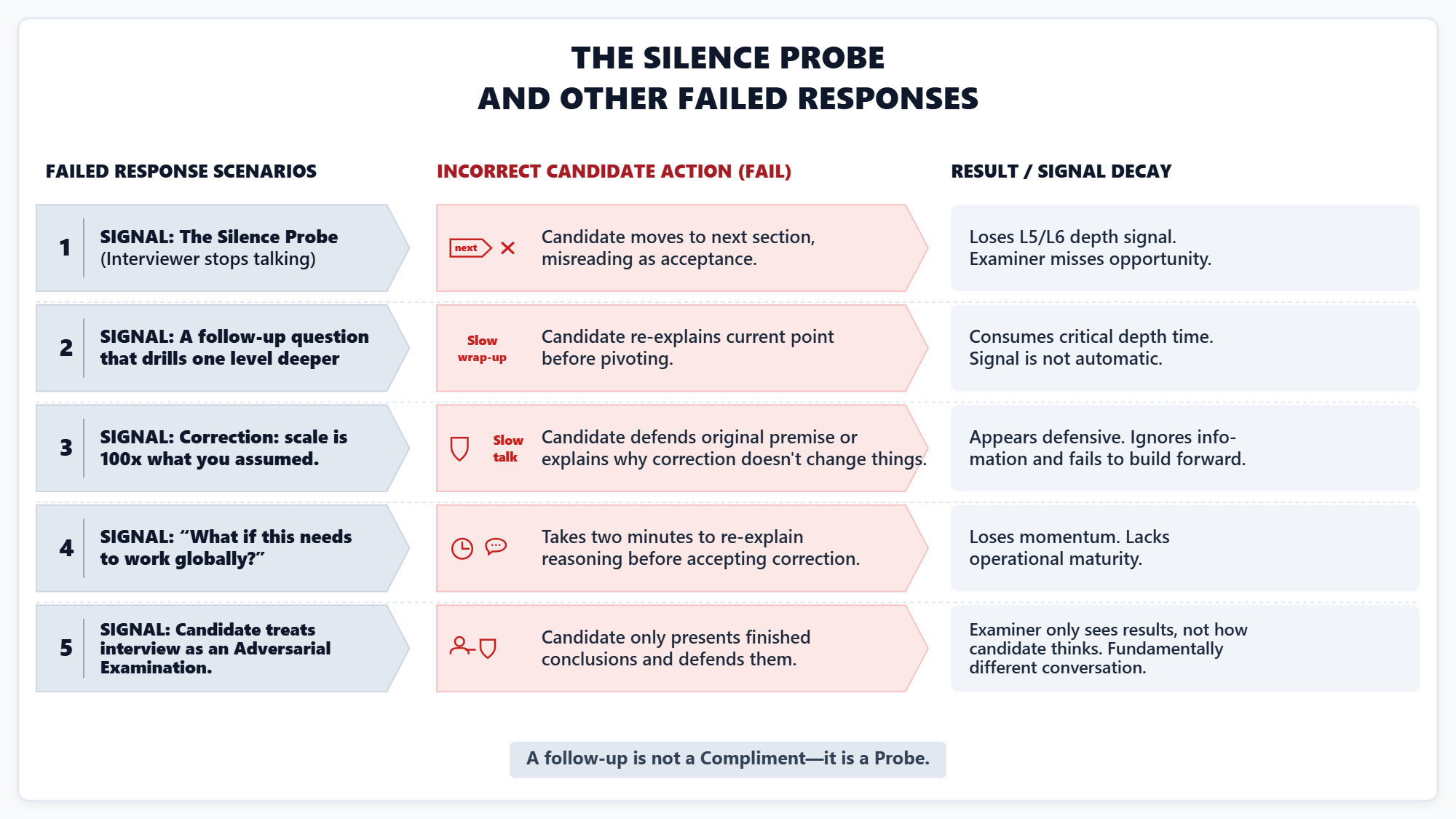
“What if this needs to work globally?”
“Let’s say the scale is 100× what you assumed.”
“Actually, multiple users can edit the file simultaneously.”
These are corrections. Not gentle suggestions — the premise you’ve been designing for is wrong and the interviewer is telling you.
The correct response: stop, acknowledge once (”Good point — let me revise”), immediately build forward on the corrected premise.
The wrong response: defending the original premise, explaining why the correction doesn’t change things significantly, or taking two minutes to re-explain your reasoning before accepting the correction.
One acknowledgment, then forward. The interviewer doesn’t need to understand why you made the original assumption. They need to see you incorporate new information and keep moving.
The silence probe
When you finish a section and the interviewer doesn’t immediately respond — they look at you, or look at the whiteboard, or just wait — this is almost always an invitation to go deeper.
The silence is not “that was fine, continue to the next section.” It’s “there’s more here, keep going.”
Most candidates treat silence as a signal to move on. The silence probe is actually the opposite: the interviewer has heard the surface answer and wants to see if you’ll surface the deeper one without being explicitly asked.
If you finish a section and get silence, don’t move to the next section. Go deeper on what you just said. Name a failure mode. Name a condition under which your design breaks. Name what you’d add with more time.
If you’ve genuinely exhausted the depth on that component, say so explicitly: “I think I’ve covered the core design here — should I move on to the data model?” This forces a response rather than leaving both of you in ambiguous silence.
Using the interviewer actively
The best candidate-interviewer dynamics aren’t interviews — they’re conversations. Candidates who treat the interviewer as a collaborator rather than an examiner consistently do better.
“I’m torn between two approaches here — let me think through both with you” is collaborative.
“I’m not sure which way this scales better — what factors would you weight more heavily?” is collaborative. It’s also information-gathering: if the interviewer says “I’d think about the write path specifically,” they’ve just told you where the probe is going.
This doesn’t mean delegating decisions to the interviewer. You still need to make choices and defend them. But using the interviewer as a thinking partner — bringing them into your reasoning process rather than presenting finished conclusions — produces a fundamentally different conversation.
That conversation is easier to score well on, because the interviewer has seen how you think, not just what you concluded.
CTA: The mock interview partners channel in the Discord is the fastest way to practice reading a real interviewer — not just a timer. Paid subscribers only.
Subscription link
https://systemdr.systemdrd.com/subscribe
—Sumedh
The Question Vault has all 52 walkthroughs organized by archetype — so you can see the pattern across questions, not just the surface answer.
Access all 52 Quesstions here