
Learn System Design with System building, Subscribe Hands On coding course - LogStream
Thirty days. One onsite loop. Here’s the plan I’d actually follow — not the plan that covers everything, because thirty days cannot cover everything, but the plan that prepares you for the specific interview in front of you.
The principle: targeted depth beats broad coverage
Thirty days of prep that covers six archetypes shallowly will lose to twenty days of prep that covers two archetypes deeply, plus ten days of mock interviews.
The engineers who pass consistently aren’t universally prepared. They’re specifically well-prepared for the questions they’re most likely to face. At most companies, a single loop involves one or two system design questions. If you know your target company’s interview patterns, you know which two archetypes to prioritize.
Research your target company before you start prep. Look at Glassdoor, Blind, and LinkedIn connections who’ve interviewed there recently. Identify the two most commonly asked archetypes. Those are your week 1 and week 2.
Week 1 (Days 1–7): Deep drill, archetype #1
Pick the most likely archetype for your target company. Read two walkthroughs from that archetype fully. Don’t drill yet — read to understand the pattern.
Then do three timed cold drills from that archetype on days 3, 5, and 7:
Set a 50-minute timer
Design on paper with no notes, no searching
When the timer ends, open the walkthrough and compare section by section
Write down the top 3 specific gaps between your answer and the walkthrough
By day 7, you should produce a structurally correct answer — not perfect, but with the right components in the right places and the key failure modes named.
Week 2 (Days 8–14): Deep drill, archetype #2
Same structure. Different archetype — your second most likely one.
After two weeks, you have deep coverage of the two archetypes most likely to come up. That alone puts you in better position than most candidates who drilled 15 questions shallowly.
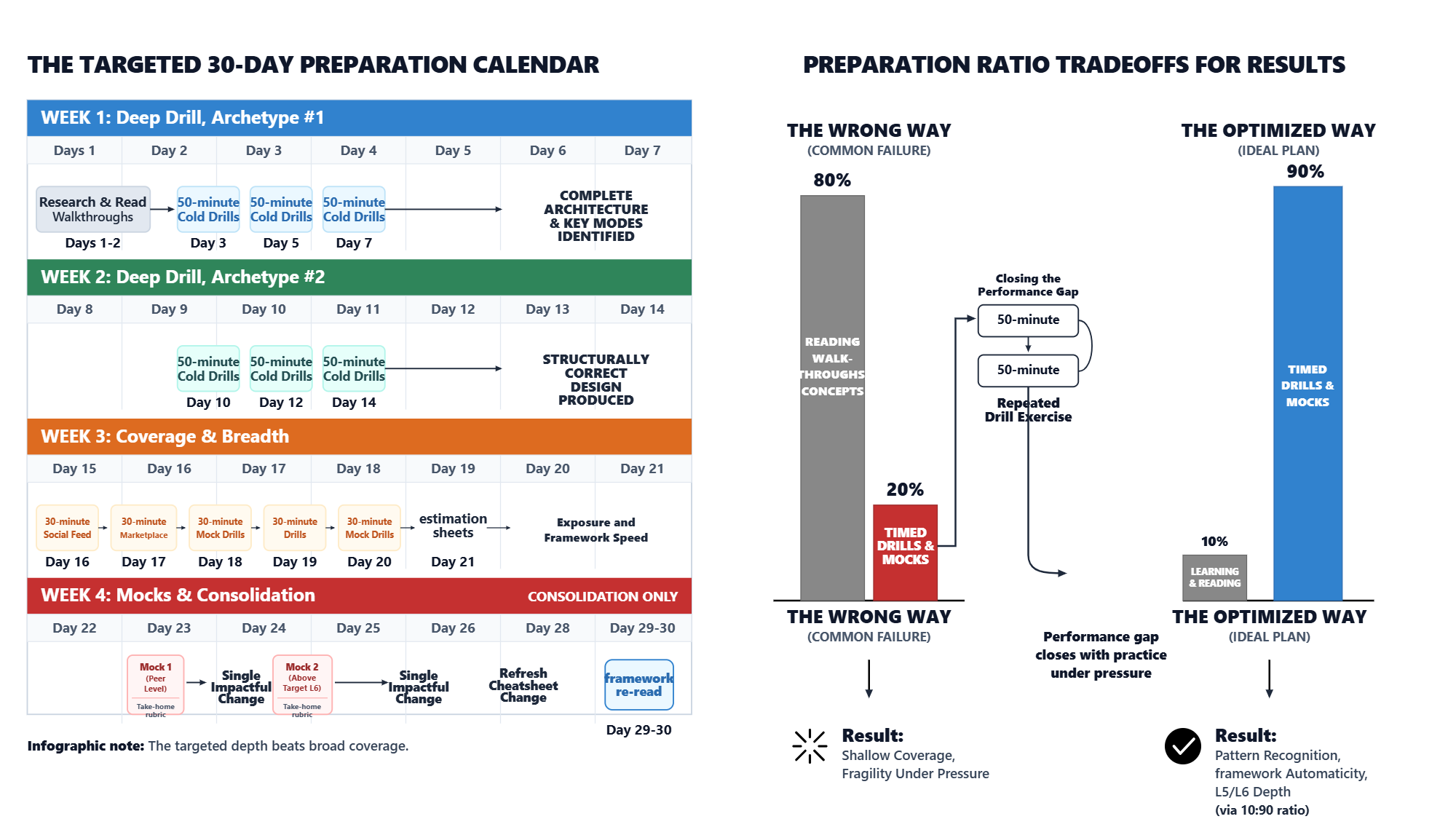
Week 3 (Days 15–21): Coverage and breadth
Spend week 3 doing shorter 30-minute drills across 4–5 archetypes you haven’t deeply covered. The goal is exposure, not mastery. Knowing the basic shape of an answer for a question you’re 20% likely to face is much better than having no answer.
The 30-minute format requires discipline: force yourself to reach the architecture step within 15 minutes. Don’t let estimation and API design consume your entire drill — practice moving through the framework efficiently.
Also in week 3: re-read the estimation numbers cheatsheet and the trade-offs cheatsheet. These apply to every question. Refreshing them mid-prep rather than at the very end gives them time to consolidate.
Week 4 (Days 22–28): Two mocks with real feedback
Stop reading. Stop drilling solo. Do two mock interviews with people who will give you specific, scored feedback.
The first mock: peer at your target level. Ask them to score you on the 8 dimensions of the take-home rubric. Ask them specifically whether your scoping, communication, and failure mode coverage were strong.
The second mock: someone above your target level. Their feedback will be harder to hear and more useful. What L6 candidates do that you’re not doing yet — that’s the gap you have four days to close before the interview.
After each mock: identify the single most impactful change. Spend two days on that one thing. One change made well is more valuable than ten changes made half-heartedly.
Days 29–30: Consolidation only
Day 29: one short drill (30 minutes), no new material. Re-read the framework cheatsheet. That’s it.
Day 30 (the day before): re-read the drill card for the archetype most likely to come up at your target company. This takes four minutes. Then stop.
Don’t read a new walkthrough the night before. New information the night before competes with everything you’ve consolidated and doesn’t have time to integrate. Rest is a legitimate and important part of preparation. Use it.
What this plan produces
After thirty days:
Two archetypes with genuine depth and pattern recognition
Coverage-level familiarity with four to five additional archetypes
Two mocks with documented gaps and one specific improvement made to each
The framework cheatsheet and estimation numbers fresh in working memory
You’ll encounter a question you’re less prepared for. When that happens, apply the framework. The six-step framework works on questions you haven’t drilled — that’s what it’s for. The warmup from four weeks of drilling makes the framework run faster and more automatically under pressure.
The thing most people get wrong
The ratio of reading to drilling in most engineers’ prep is about 80:20. Reading walkthroughs, reading concept explainers, reading other people’s summaries.
The ratio that produces results is closer to 40:60 — 40% reading and learning, 60% timed drills and mocks. The performance gap between knowing something and producing it under pressure in front of someone is real and only closes with practice under pressure.
If you have thirty days and you spend twenty-five of them reading, you’ve done the easy part and skipped the hard part. Do the hard part.
The Question Vault has all 52 walkthroughs organized by archetype — so you can see the pattern across questions, not just the surface answer.
Access all 52 Questions here
CTA:
Paid subscribers get one full system design walkthrough
every Tuesday — each mapped to its archetype so you build
pattern recognition, not answer memorization.
This week: Google Drive / Dropbox.
https://systemdr.systemdrd.com/subscribe
Subscription link
https://systemdr.systemdrd.com/subscribe
—Sumedh
Want the complete learning path?
Unlock advanced modules, case studies, and guided exercises.