
After the trade-offs section, before the interviewer wraps up, there is a 2-minute move that upgrades a Hire to a Strong Hire more reliably than anything else:
Name two failure modes you haven’t fixed and the conditions under which you’d revisit the design.
Not generic failure modes. Specific ones from your design.
“The two things I’d revisit: first, if the celebrity threshold for switching from fanout-on-write to fanout-on-read turns out to be lower than 1M followers in practice — I’d tune it based on actual write amplification metrics after the first week in production. Second, if the change_log grows faster than anticipated — I’d add a compaction job earlier than the 30-day window I assumed.”
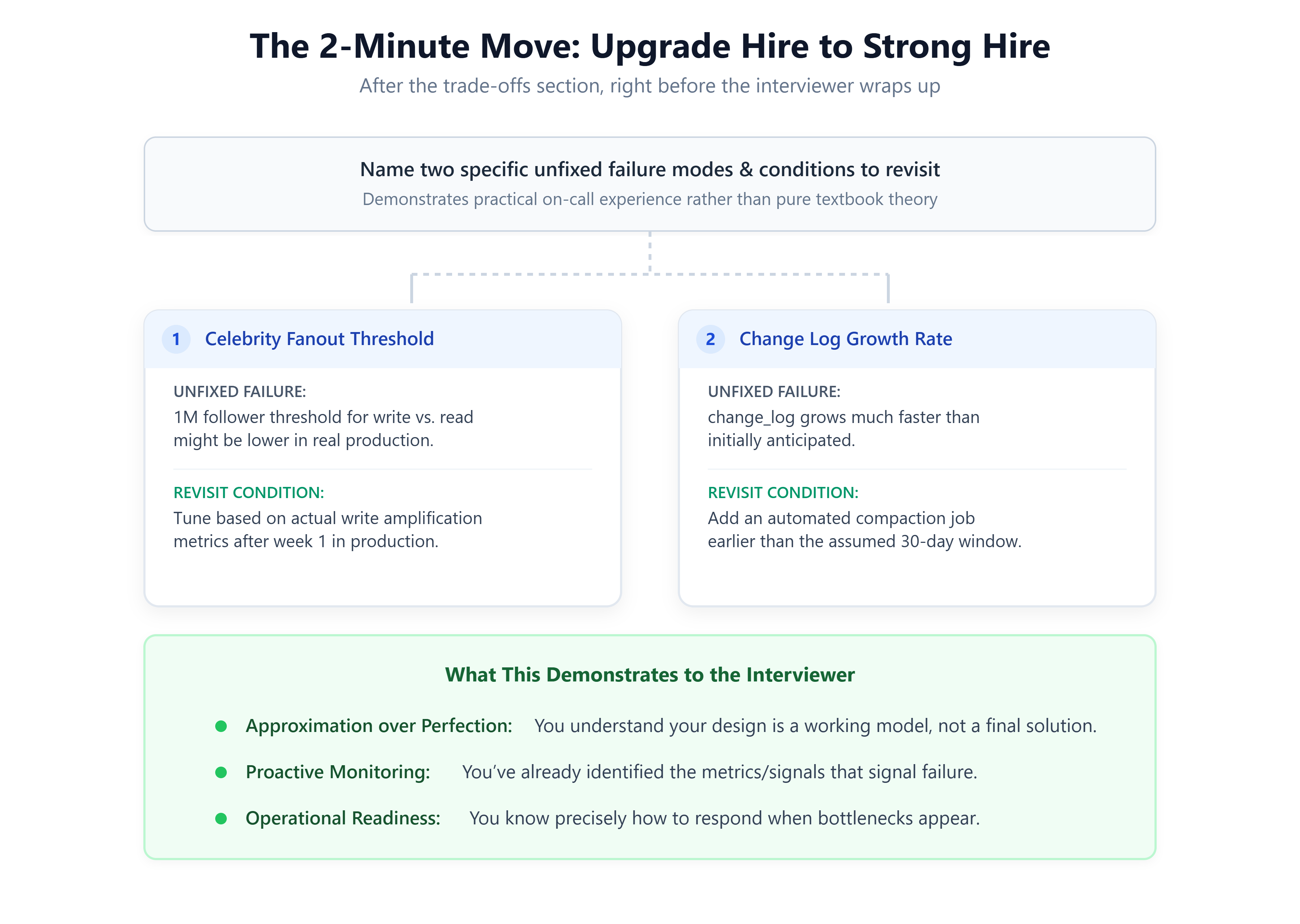
This demonstrates:
1. You understand your design is an approximation, not a solution.
2. You’ve already thought about the monitoring signals that would tell you it’s failing.
3. You know how to respond when it fails.
That’s the entire difference between a candidate who has read about systems and a candidate
who has been on-call for them.
CTA: The cohort curriculum goes beyond textbook designs — training you to proactively identify specific failure modes, establish clear production monitoring thresholds, and articulate exact trigger conditions for revisiting architecture before an interviewer even asks.
Subscription link
https://systemdr.systemdrd.com/subscribe
This free lesson is designed to get you started.
The paid content helps you master the topic with structured deep dives.