
The three-sentence pattern
1. The choice: What you decided.
2. The reason: Why you decided it (linked to a specific constraint or number from your estimation).
3. The revisit condition: Under what specific change would you make a different decision?
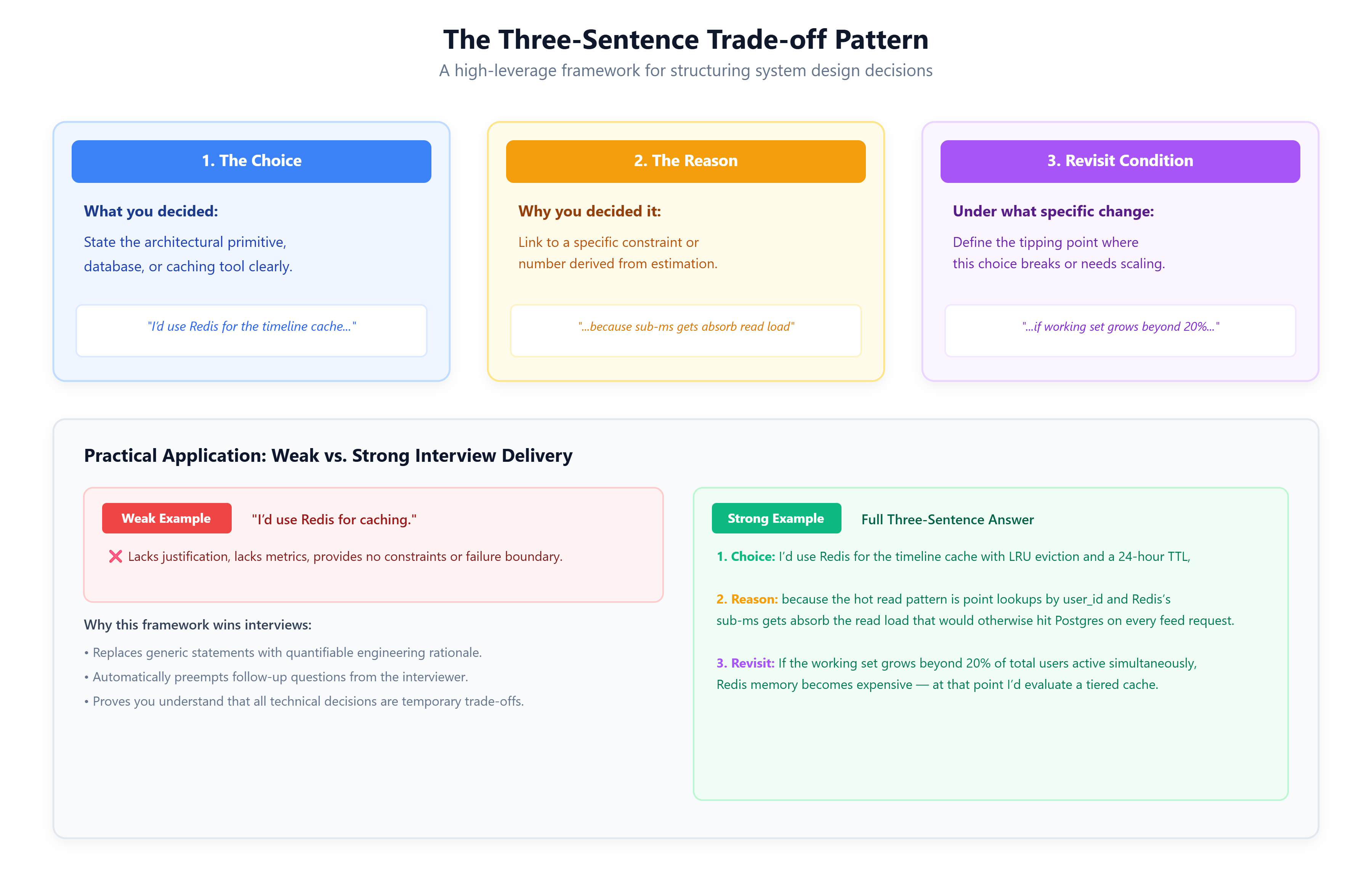
Example (weak): ‘I’d use Redis for caching.’
Example (strong): ‘I’d use Redis for the timeline cache with LRU eviction and a 24-hour TTL, because the hot read pattern is point lookups by user_id and Redis’s sub-millisecond gets absorb the read load that would otherwise hit Postgres on every feed request. If the working set grows beyond 20% of total users being active simultaneously, Redis memory becomes expensive — at that point I’d evaluate a tiered cache or move to Memcached.
CTA: The cohort curriculum trains you to replace vague design choices with the three-sentence framework — teaching you to state exact technical decisions, ground your choices in concrete system constraints, and define precise monitoring triggers to revisit trade-offs under scale.
Subscription link
https://systemdr.systemdrd.com/subscribe
Interested in mastering this topic?
Unlock premium content with deeper explanations and real implementation patterns.