
Every quarter I look at the analytics across the full archive and find the same surprise: the highest-clicked posts aren’t the ones I thought were the best.
After running the newsletter for six months, here’s what the data shows about what actually resonates — and what it means for how you should be reading.
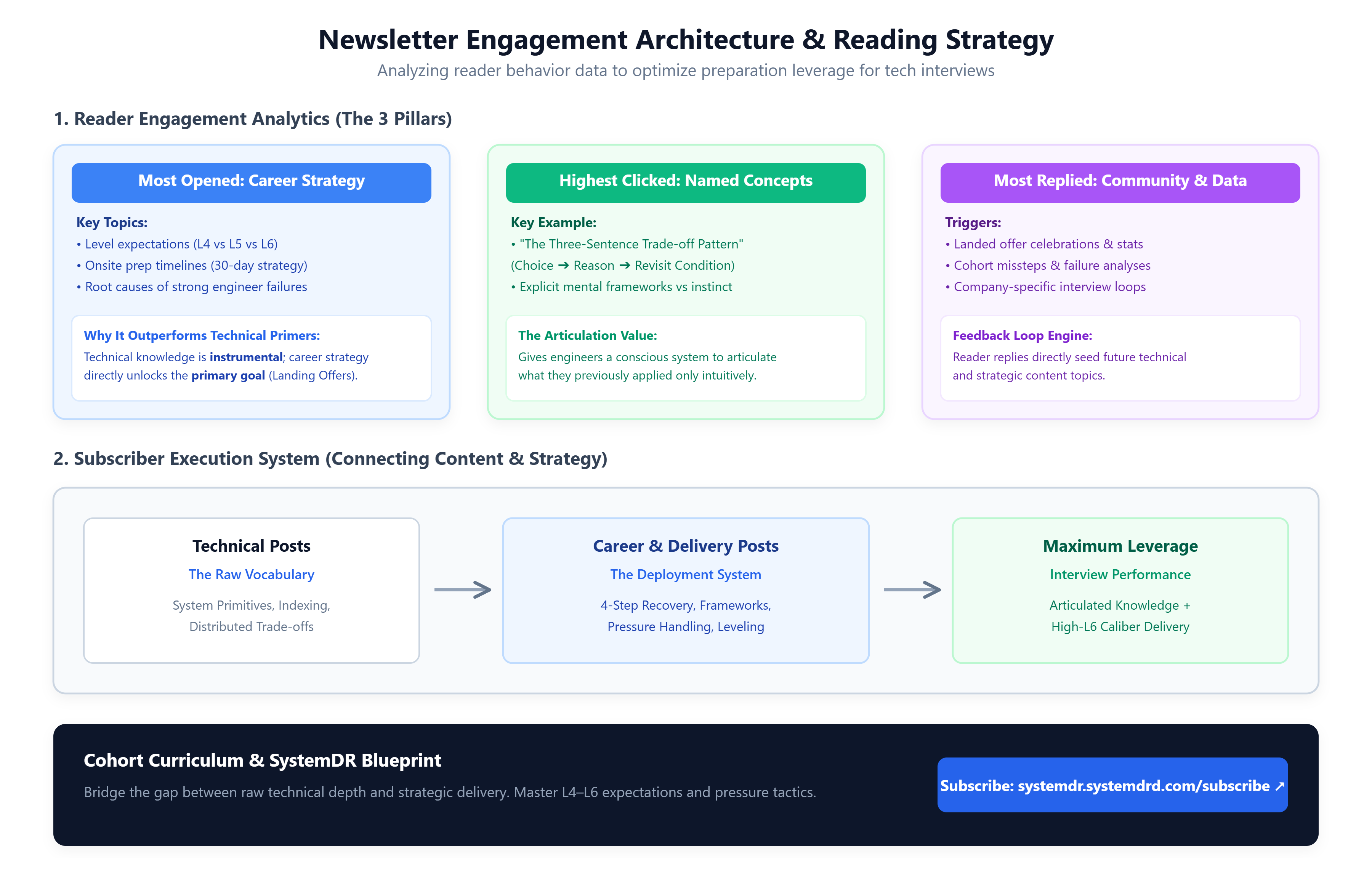
The most-opened posts are the career ones
Posts about levels (L4 vs L5 vs L6), about preparing in the month before an onsite, about why strong engineers fail — these consistently outperform the technical concept primers.
This makes sense in retrospect. Engineers subscribe to this newsletter because they have a goal: pass an interview and get an offer. The career posts speak directly to that goal. The technical posts are instrumental to the goal.
The implication: if you find yourself skipping the career posts and reading only the technical ones, you’re probably missing the higher-leverage content.
The highest-clicked posts are the ones that name something
The best-performing posts have one thing in common: they name a specific concept, pattern, or failure mode that the reader has encountered but couldn’t articulate.
“The three-sentence pattern” (choice, reason, revisit condition) was the most-forwarded piece in the archive’s first three months. Not because engineers didn’t know how to explain trade-offs — they did. But because naming the pattern explicitly gave them a framework they could apply consciously instead of relying on it when it worked and missing it when it didn’t.
The most-replied posts are the community ones
Every time I write about offers landed, or about what cohort members got wrong, or about specific company interview patterns — I get more replies than from any technical post.
The replies tell me what to write next. Someone will reply “I’ve noticed the same thing at Amazon specifically — can you write more about what their interviewers actually probe?” and that becomes the seed for a future post.
If you’re reading a post and you have a reaction — agreement, disagreement, a story that contradicts mine — reply. It improves the newsletter, and if the exchange is interesting and you’re okay with being anonymized, it often becomes a future post.
What this means for subscribers who are actively prepping
Read the technical posts for the content. Read the career posts for the strategy. They’re meant to work together — the framework tells you how to use the content.
If you’re four weeks from an onsite and you’re using your Sunday reading time to read one more technical concept primer: consider reading the career post instead. You probably have the technical vocabulary you need. What the career posts give you is the system for deploying it under pressure.
One practical recommendation: if you’ve been subscribed for more than 8 weeks, go back to the archive and read every career post you’ve skipped. In sequence, they form something close to a complete interview strategy. Any single post is useful in isolation. Together they’re a coherent system.
CTA: The cohort curriculum bridges the gap between raw technical depth and strategic delivery — equipping you with explicit frameworks to articulate complex concepts, actionable career strategy to navigate L4–L6 expectations, and the exact deployment tactics needed to perform under pressure.
Subscription link
https://systemdr.systemdrd.com/subscribe
Looking for more practical examples?
The premium version includes projects, templates, and real-world scenarios.