
Learn System Design with System building, Subscribe Hands On coding course - LogStream
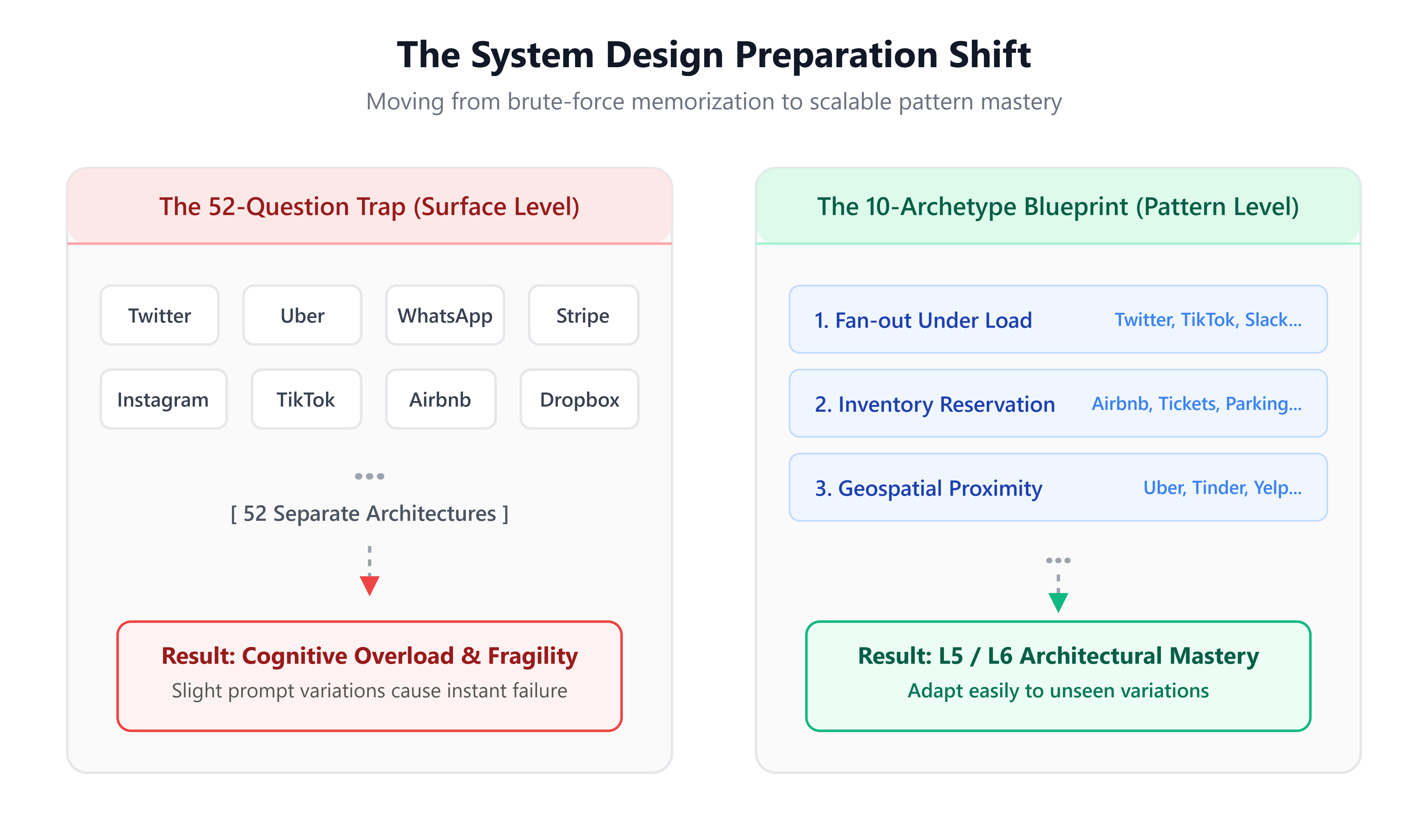
There are 52 questions in the FAANG system design question bank. Engineers preparing for FAANG-tier interviews often drill them one by one: design Twitter, then design Uber, then design WhatsApp, then design Stripe.
This is the wrong approach. Not because the questions don’t matter — they do. But because drilling 52 individual questions treats each one as unique when most of them are the same question with a different surface.
Here’s what I mean.
The 10 underlying problems
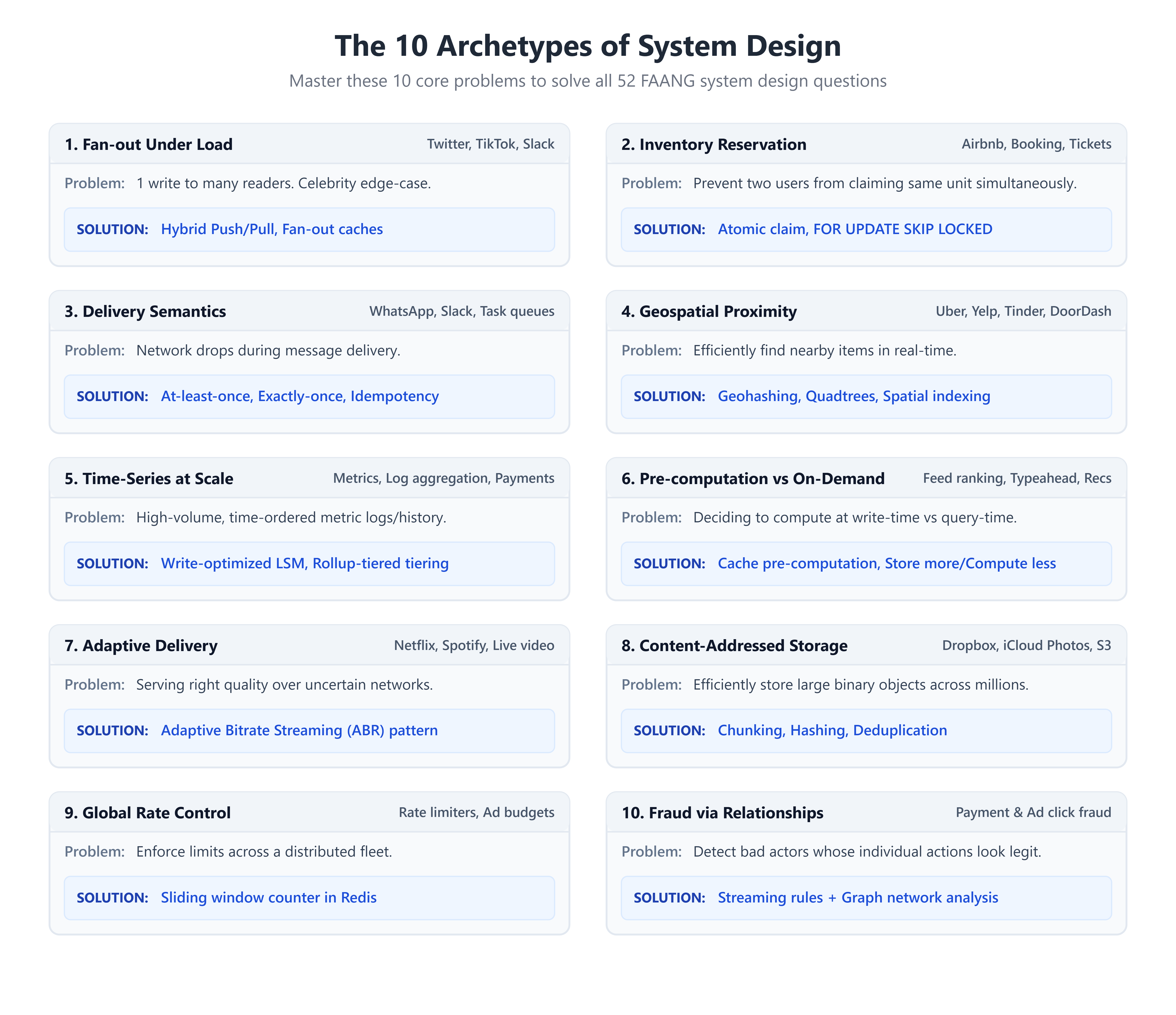
Every system design question is fundamentally an instance of one or more of these:
Fan-out under load — how do you efficiently deliver one write to many readers? Twitter’s feed, Instagram’s feed, TikTok’s feed, Slack’s channel messages, notifications. All the same problem. The celebrity/large-group edge case appears in all of them.
Inventory reservation — how do you prevent two users from claiming the same unit simultaneously? Airbnb’s booking, ticket booking, parking lot reservation. All the same atomic-claim-under-contention problem. The same FOR UPDATE SKIP LOCKED pattern solves all three.
Delivery semantics under failure — what happens when the network drops in the middle of a message delivery? WhatsApp, Slack, notification services, task queues. All wrestling with at-least-once vs exactly-once and the FLP impossibility argument.
Geospatial proximity — how do you efficiently find nearby things in real time? Uber’s driver matching, Yelp’s restaurant search, Tinder’s candidate discovery, DoorDash’s Dasher assignment. Geohashing or quadtrees. Same index. Different shape of data.
Time-series at scale — how do you store and query data that’s ordered by time and written at massive volume? Metrics monitoring, log aggregation, ride history, payment history. Same write-optimized, rollup-tiered architecture.
Pre-computation vs on-demand — when do you compute the answer at write time vs query time? Feed ranking, typeahead, recommendation engines. Same trade-off: store more, compute less per query.
Adaptive delivery — how do you serve the right quality given uncertain network conditions? Netflix streaming, Spotify, live video, file transfer. Same ABR pattern. Different media format.
Content-addressed storage — how do you store large binary objects efficiently across millions of users? Dropbox, iCloud Photos, any file storage product. Same chunking, hashing, deduplication pattern.
Global rate control — how do you enforce a limit across a distributed fleet of servers? Rate limiters, budget pacing in ad systems, quota enforcement. Same sliding window counter in Redis.
Fraud via relationship patterns — how do you detect bad actors whose individual actions look legitimate? Payment fraud, ride-share fraud, ad click fraud. Same two-layer architecture: streaming rules for velocity, graph analysis for network patterns.
What this changes about preparation
Once you see the underlying patterns, the preparation strategy changes.
Instead of drilling 52 individual questions, drill 10 problem types. When you understand fan-out deeply — the write amplification, the celebrity threshold, the hybrid approach — you can answer Twitter’s timeline, Instagram’s feed, TikTok’s FYF, and Slack’s channels as variants of the same problem. The surface details change. The architecture doesn’t.
This is why the question bank is organized by archetype, not by company. Twitter’s timeline is filed under “Social Feed” alongside Instagram, TikTok, and Reddit. Uber is filed under “Marketplace & Matching” alongside Airbnb, Tinder, and DoorDash. The point is to make the pattern visible.
The test you can run right now
Take any two questions from your preparation list. Can you identify the one or two underlying patterns they share? If yes, drilling one deeply makes the other easier. If no — reply to this post and I’ll map it for you.
The engineers who consistently pass at L5 and L6 don’t have 52 memorized answers. They have 10 deeply understood patterns and the ability to apply them to a question they haven’t seen before.
That second skill is what the interview is actually testing.
The Question Vault has all 52 walkthroughs organized by archetype — so you can see the pattern across questions, not just the surface answer.
Access all 52 Quesstions here
Subscription link
https://systemdr.systemdrd.com/subscribe
—Sumedh
Want the complete learning path?
Unlock advanced modules, case studies, and guided exercises.