
The most common reason technically strong candidates get a “Hire” instead of “Strong Hire” is not technical depth. It’s running out of time before demonstrating it.
The deep dive section — the hard distributed systems problem at the center of the question — is where L5 separates from L4, and where L6 separates from L5. It’s also the section that gets cut when the interview runs short. You spent 20 minutes on estimation and API design and now you have 10 minutes left for the architecture and zero for the deep dive.
The fix is specific time checkpoints that you self-enforce in the room. Not approximate — specific.
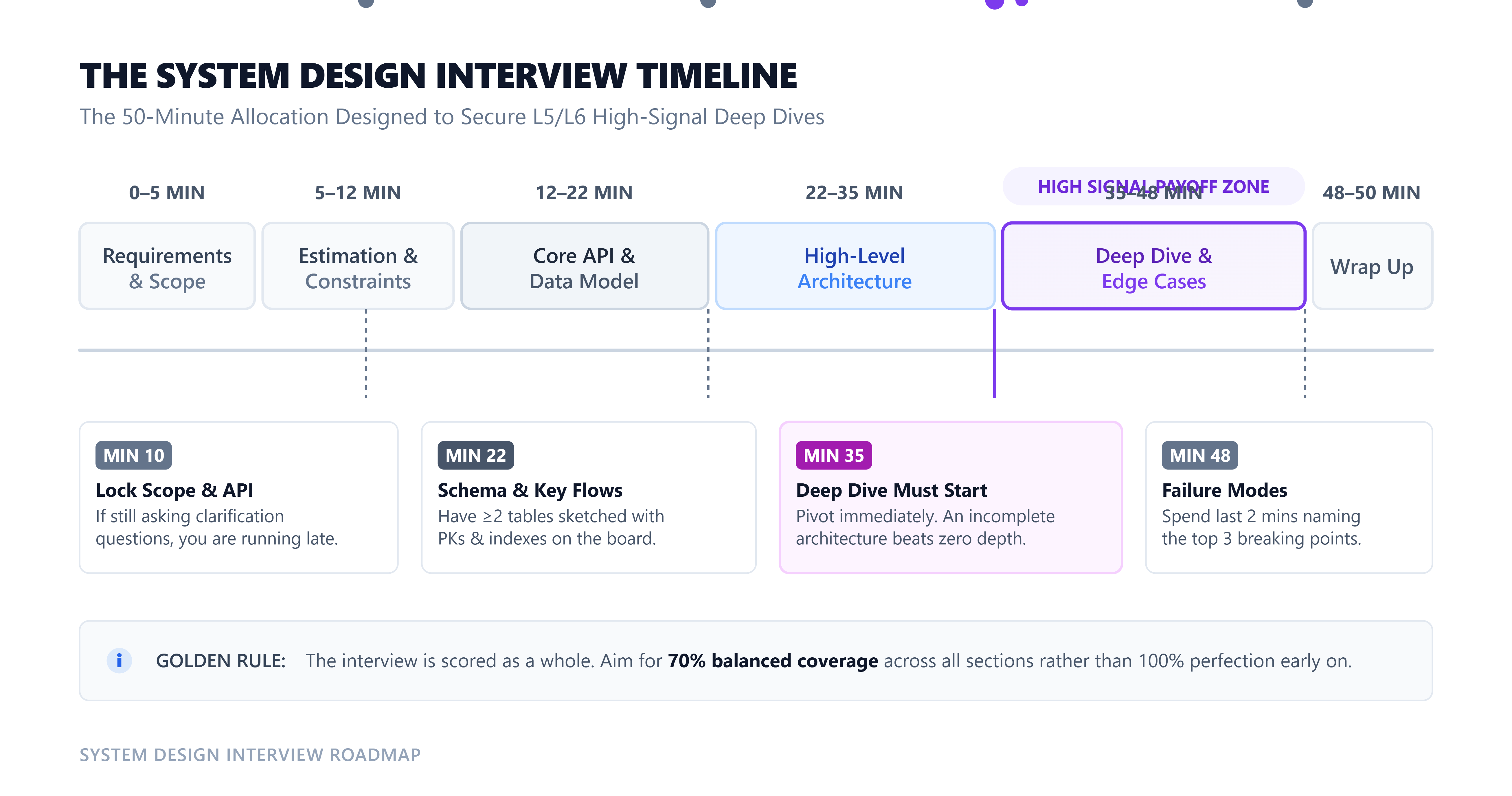
The 50-minute allocation
Here is the allocation that consistently produces complete answers with time for depth:
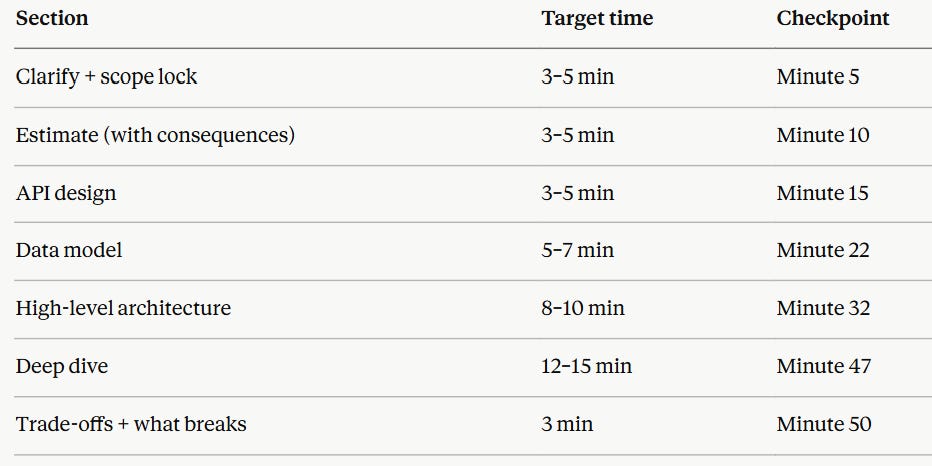
Total: 45–47 minutes, leaving a 3–5 minute buffer.
The checkpoints to self-enforce
Minute 10: API must be drafted and scope must be locked. If you’re still asking clarifying questions at minute 10, you’ve spent your estimation time and you’ll have to compress the data model.
Minute 22: Schema and key flows should be on the board. At this point you should have: at least two tables sketched with primary keys and indexes, and at least one paragraph of the architecture explained. If you’re still on API design at minute 22, move immediately.
Minute 35: The deep dive must be in progress. Not about to start — actually underway. If you’re at minute 35 with only the high-level architecture sketched and no deep dive started, you have a problem. Stop the high-level walkthrough and pivot to the deep dive now. An incomplete high-level architecture plus a solid deep dive is worth more than a complete architecture with no deep dive.
Minute 48: Trade-offs and failure modes should be underway. If you’re still deep-diving at minute 48, spend the last two minutes naming the top three things that break in your current design and what you’d do about them. Even naming them without a full answer is better than silence.
The discipline required
The hardest part of time management is stopping something that’s going well to move on.
You’re mid-explanation of the data model. It’s going well. You understand this part. The interviewer is nodding. You want to finish the thought.
Move anyway. The next section matters more than this one continued.
The data model section’s job is to demonstrate that you can design appropriate schemas with the right indexes and sharding strategy. Once that’s demonstrated — once you’ve covered the main table, the partition key, and at least one non-obvious design decision — the section is done. More detail doesn’t add signal; it steals time from sections where signal is still available.
What to do when you fall behind
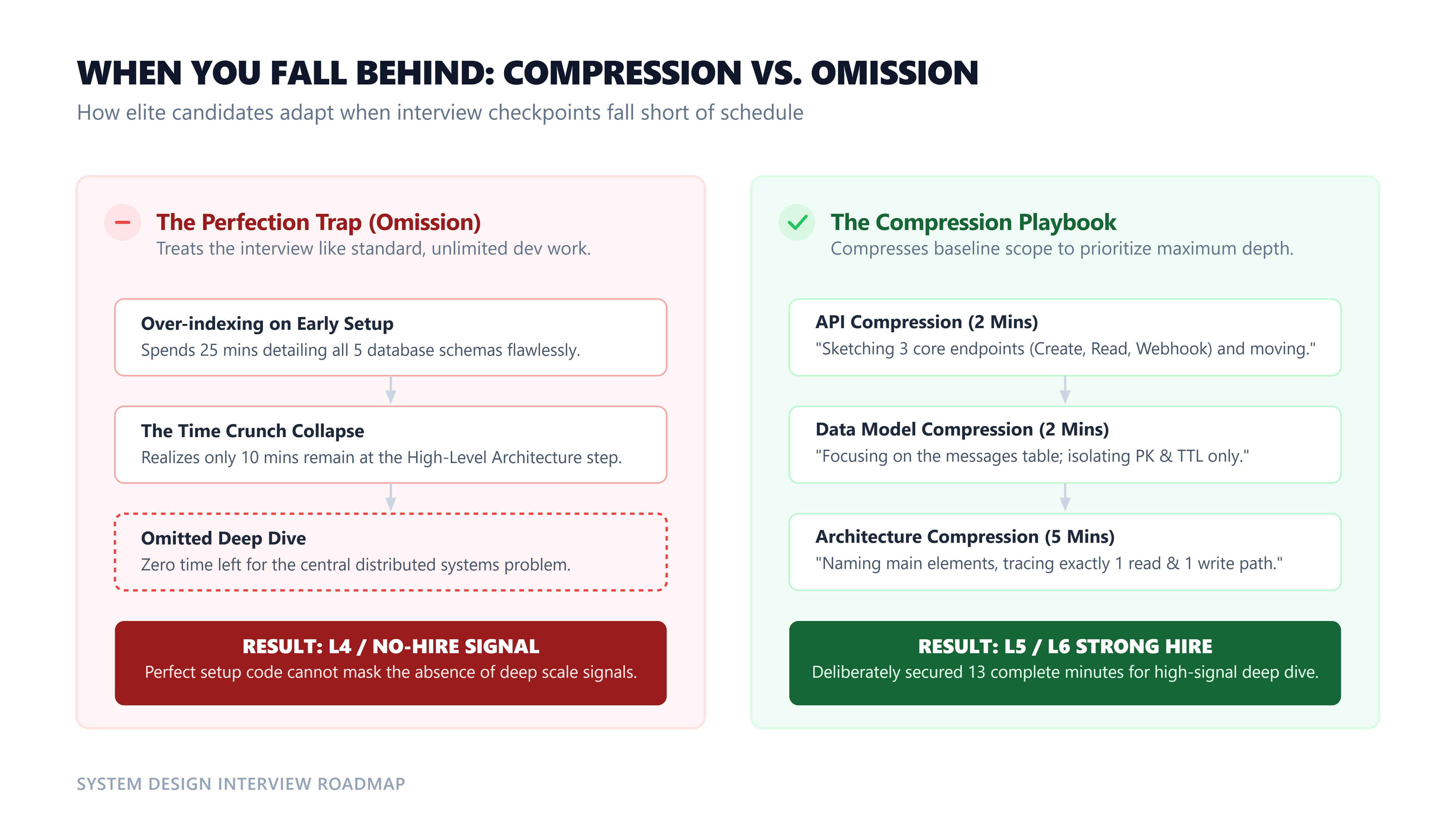
If you realize you’re behind the checkpoints, the correct response is compression, not panic.
For the architecture: “Let me give you the key components and the main flows rather than a complete walkthrough.” Five minutes instead of ten. Names the components, traces one read path and one write path, stops.
For the data model: “The critical table here is the messages table — let me focus on that one rather than all five tables.” Two minutes instead of seven. Names the partition key, names the TTL strategy, stops.
For the API: “Three endpoints — the core create, read, and webhook. Let me sketch those quickly.” Two minutes. Moves on.
Compression is always better than omission. A compressed section signals that you know what you’re doing and are managing time deliberately. An omitted section is a missing signal.
The permission to be incomplete
Most engineers feel they should finish each section before moving to the next. This intuition works in normal engineering work. In a timed interview, it’s wrong.
The interview is scored as a whole, not section by section. A round with complete clarification, estimation, API, data model, architecture, deep dive, and trade-offs — each at 70% coverage — scores better than a round with perfect clarification, estimation, and API at 100% coverage with no deep dive.
The deep dive is the section with the highest score differential. It’s where the round is decided. Everything before it is the setup. Don’t let the setup consume so much time that the payoff never arrives.
CTA: The drill cards have a time-box bar at the bottom of every card — the exact minute allocation for that specific question, weighted toward where the probe lands. All 37 are in the Vault.
Curious how this works in real systems?
The paid lessons cover scalability, optimization, and real-world engineering patterns.
Subscription link
https://systemdr.systemdrd.com/subscribe
—Sumedh
The Question Vault has all 52 walkthroughs organized by archetype — so you can see the pattern across questions, not just the surface answer.
Access all 52 Questions here