Introduction
You’re streaming a 4K video on YouTube when suddenly your Wi-Fi hiccups. A single lost packet freezes all 127 video chunks in transit—not because they’re damaged, but because TCP won’t deliver chunk #43 until it retransmits the missing packet #42. Meanwhile, chunks #44 through #127 sit idle in kernel buffers, perfectly intact but artificially stalled. This is head-of-line blocking, and it’s why Google spent five years rebuilding the internet on UDP.
The Fundamental Problem
Head-of-line blocking (HOL blocking) occurs when one slow or failed resource prevents processing of subsequent independent resources. In HTTP/1.1, this happened at the application layer: browsers opened 6 connections per domain, but within each connection, requests queued serially. Request #2 couldn’t start until #1 completed, even if #2’s resource was ready. HTTP/2 solved this with multiplexing—sending multiple requests over a single TCP connection using stream IDs.
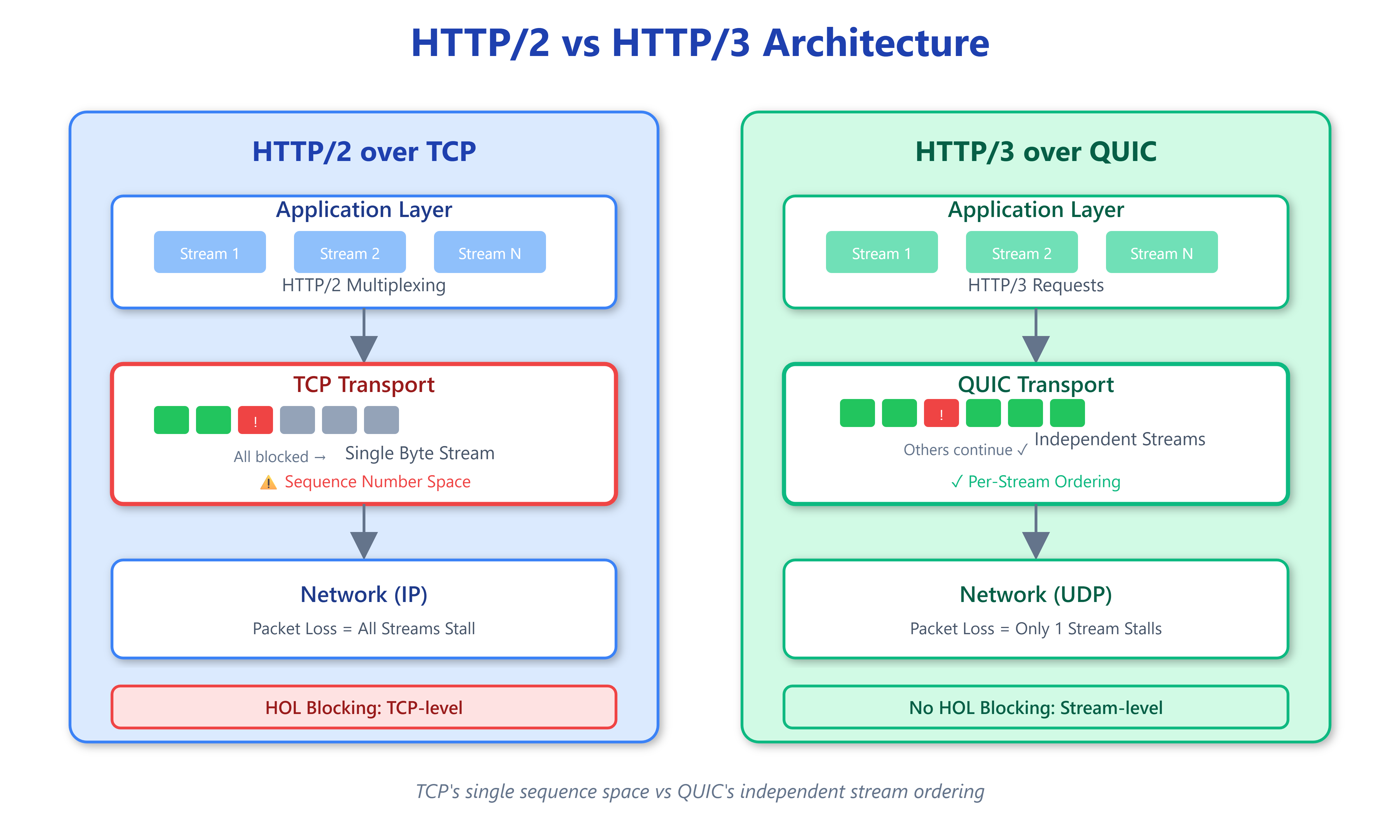
But HTTP/2 introduced a deeper problem at the transport layer. TCP guarantees in-order delivery of bytes. When packet #42 drops on a connection carrying 100 multiplexed streams, TCP’s receive buffer holds packets #43-127 but refuses to deliver them to the application. The kernel waits for retransmission of #42, stalling all 100 streams even though 99 streams have no dependency on that lost packet. This is TCP-level HOL blocking, and it’s invisible to HTTP/2’s multiplexing.
HTTP/3 fundamentally restructures this relationship by running on QUIC, which implements streams natively in the transport layer over UDP. Each QUIC stream maintains independent packet ordering. When stream #5 loses a packet, only stream #5 stalls—streams #1-4 and #6-100 continue delivering data immediately. QUIC also integrates TLS 1.3 handshake into connection establishment, reducing RTTs from 3 to 1 for new connections and enabling 0-RTT resumption for repeat visitors.
The implementation difference is architectural. TCP operates on a byte stream abstraction with a single sequence number space. QUIC maintains per-stream offset tracking with independent acknowledgment state machines. When you send 100 HTTP/3 requests, you’re creating 100 logical channels with separate congestion control feedback but shared connection-level flow control. Packet loss affects only the stream(s) in that packet, not the entire connection.