
The message usually reads: "I have an L5 offer, but I think I could get L6. Should I push for the level or take it?"
Most advice answers with a number. The better answer starts with three questions, and only one of them is about the interview.
The real question isn't the level
"Take L5 or hold out for L6?" is really three questions:
Are you already doing L6 work in your current role?
Did the interview give real signal that you're close to L6?
What does waiting cost you?
Most people only think about the second one. The other two decide the outcome just as often.
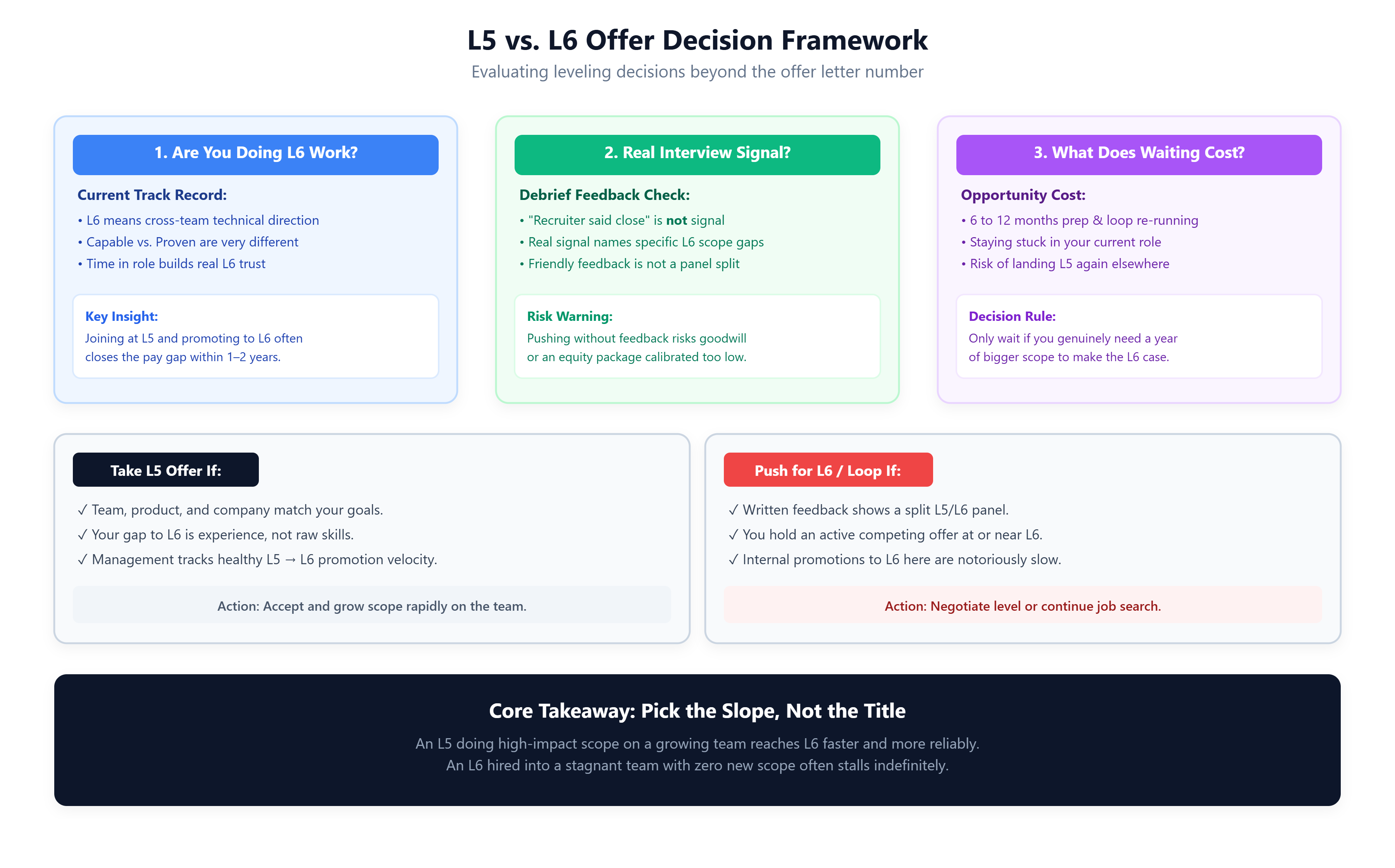
1. Are you already doing L6 work?
At most large tech companies, L6 (Staff at Google, E6 at Meta) means you set technical direction for a team or product area, your work reaches across teams, and your decisions carry real business weight.
If you're a senior engineer whose decisions mostly shape your own work, you're probably not there yet. Being capable of L6 and having a track record at L6 are different things. An interview can test the first; only time in the role builds the second.
An L5 who does L6 work after joining is on the normal promotion path. Over a year or two, the pay gap between "hired at L6" and "promoted to L6" is often smaller than it looks on the offer letter.
2. Did the interview give real L6 signal?
"The recruiter said I was close to L6" is not the same thing.
Real signal sounds like specific debrief feedback that names L6 as a possible outcome and points to gaps you can close with scope, not skills you lack. For example: "Strong L5. Clear signals on operational maturity and cross-team influence. Could see L6 with more scope."
"We'd love to revisit your level later" and "you're one of our strongest L5 candidates" are friendly. They aren't signal.
If the feedback is vague and you push anyway, the likely results are: the level stays the same and you've spent goodwill, or you get the L6 title with an equity package calibrated low. The money moves less than the title.
3. What does waiting cost?
Waiting means turning this offer down, preparing more, and running another loop somewhere else in 6 to 12 months.
The costs are real: another loop's worth of evenings, the chance it ends at L5 again, and a year of the role you're in now. Waiting is worth it only if you genuinely need that year of bigger scope to make an L6 case. The next interview will show whether you did.
The practical answer
Take the L5 offer if:
The company, team and product are where you want to be.
Your gap to L6 is experience, not skills.
People there get promoted from L5 to L6 on a reasonable timeline. Ask your future manager how many of their L5s made L6 in the last two years.
Push for L6, or keep looking, if:
You have written feedback that the panel was split between L5 and L6.
You have a competing offer at or near L6.
Promotion to L6 at this company is known to be slow or political.
The level on day one matters less than the slope after it. An L5 doing L6 work on a team with room to grow gets there. An L6 hired into a team with no new scope often stalls.
Pick the slope, not the title.
Next up
This week's paid walkthrough shows what L6 scope looks like in a real design: Design a Webhook Delivery System, where the Staff answer is about second-order effects, not more boxes. Next Sunday: why your deep dives aren't landing.