
This is a question I get in some form almost every week. Usually it sounds like: “I have an L5 offer at SystemDr, Inc but I think I could get L6. Should I negotiate up or take it?”
The honest answer is: it depends on factors that most advice skips. Here’s the framework I actually use.
The real question isn’t about the level
The question “should I take L5 or hold out for L6” is actually three separate questions:
Are you currently performing at L6 in your current role?
Did the interview process give genuine signal that you’re close to L6?
What are the costs of waiting?
Most people asking this question are only thinking about question 2. The other two matter as much.
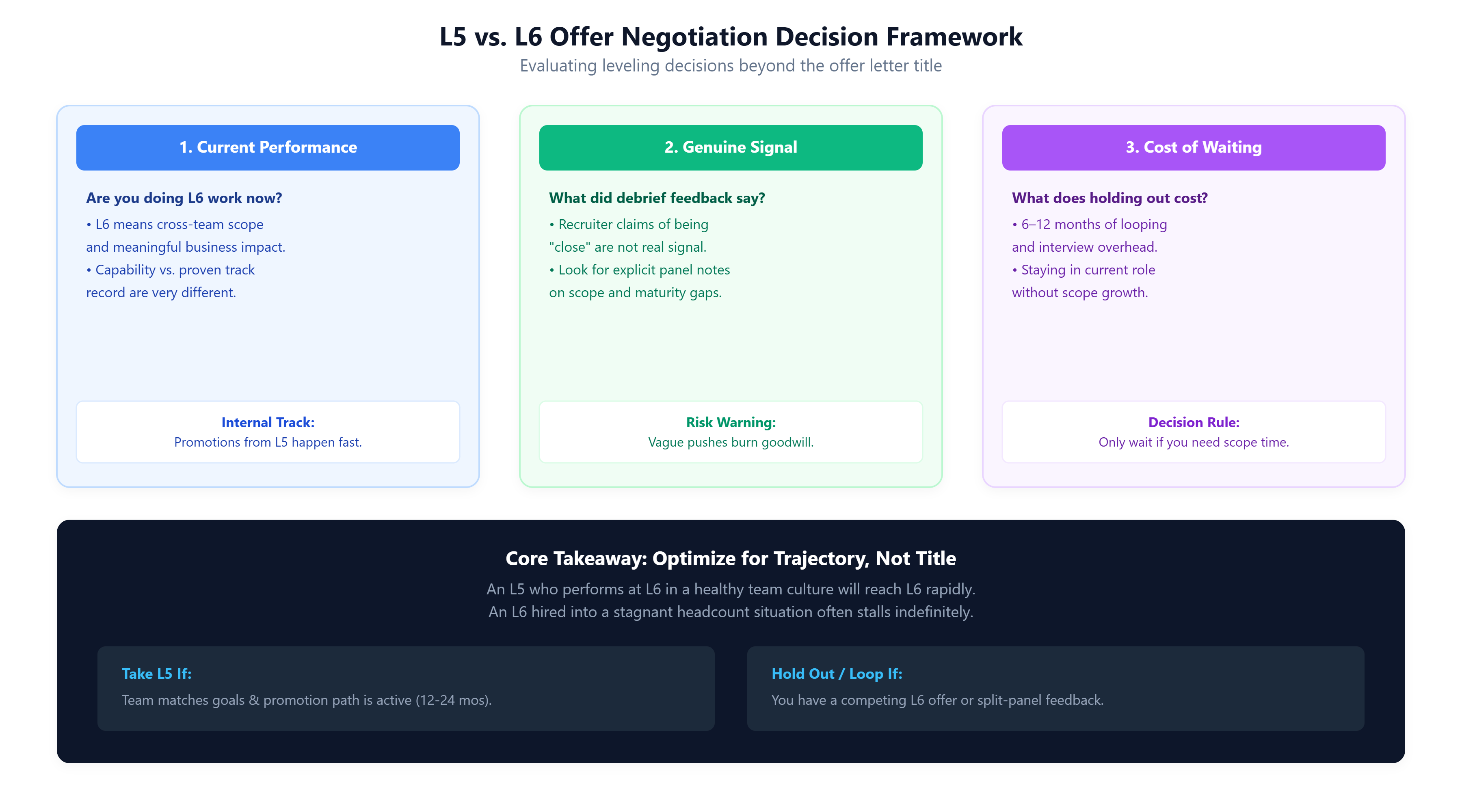
Question 1: Are you currently performing at L6?
L6 at most FAANG companies means: you’re driving technical direction for a team or product area, your work has cross-team or cross-org impact, and your decisions have meaningful business consequences.
If you’re currently a Senior Engineer at a mid-stage startup making principally individual contributor decisions, you’re probably not there yet. Being smart enough for L6 and having the demonstrated track record for L6 are different things. The interview can assess the former; only experience develops the latter.
If you take an L5 role and perform at L6 within 12–18 months, you’ll be promoted. That’s the standard internal path and it’s not slow — at most major companies, an L5 who performs at L6 gets promoted at the next review cycle. The salary difference over 18 months is usually smaller than it looks.
Question 2: Did the interview give genuine L6 signal?
“The recruiter said I was close to L6” is not the same as genuine L6 signal.
Genuine L6 signal: the debrief feedback explicitly mentions L6 as a possible outcome, and the gaps cited are addressable with experience rather than skills you don’t have. “Strong L5, strong signals in operational maturity and cross-functional influence — could see L6 with more scope” is meaningful feedback.
“We’d love to revisit your level in the future” or “you’re one of our strongest L5s” is not L6 signal. It’s standard recruiter language.
If the feedback is vague and the recruiter is suggesting you could negotiate, the realistic outcome of pushing for L6 is either: the offer is rescinded (unlikely but not impossible), the level stays the same and you’ve burned goodwill, or they technically offer L6 but calibrate your starting equity and bonus expectations accordingly. The number changes less than the title.
Question 3: What are the costs of waiting?
Waiting means: declining this offer, preparing more, and attempting another loop at another company in 6–12 months.
The costs are real: opportunity cost of staying in your current role, the mental and time overhead of another loop, the risk that the next loop also results in an L5 offer or no offer.
The benefit: if you genuinely need 6–12 months of more senior scope to credibly target L6, you should take the time. The interview will show it.
The practical answer
Take the L5 offer if:
The company, team, and product are where you want to be
The gap to L6 at that company is primarily experience, not skills
Internal promotion timelines are reasonable (most major tech companies: 12–24 months from strong L5 to L6)
Hold out (or negotiate) for L6 if:
You have concrete feedback that the interviewers were split between L5 and L6
You have a competing offer at or near L6 to use as leverage
The company’s internal promotion path to L6 is politically difficult or slow
The level on the offer letter matters less than your trajectory after joining. An L5 who performs at L6 in a company with a healthy promotion culture will get to L6. An L6 hired into a frozen headcount situation with no visibility into new scope will not.
Optimize for the trajectory, not the title on the first day.
CTA: The cohort curriculum equips you to demonstrate genuine Staff-level signals before you ever enter a leveling debrief — training you to project cross-team architectural scope, communicate business-level trade-offs with operational maturity, and navigate L5 vs. L6 career decisions for long-term trajectory rather than just a day-one title.
Subscription link
https://systemdr.systemdrd.com/subscribe
Take your understanding further with premium lessons covering advanced strategies, debugging techniques, and best practices.