
The system design interview round has a failure rate that surprises most engineers when they first encounter it. Strong engineers — people who are genuinely good at their jobs, who have built real systems, who know distributed systems concepts — fail this round at a rate that doesn’t correlate with their actual technical competence.
After reading enough post-mortems, the failure pattern is consistent. It’s almost never the technical content.
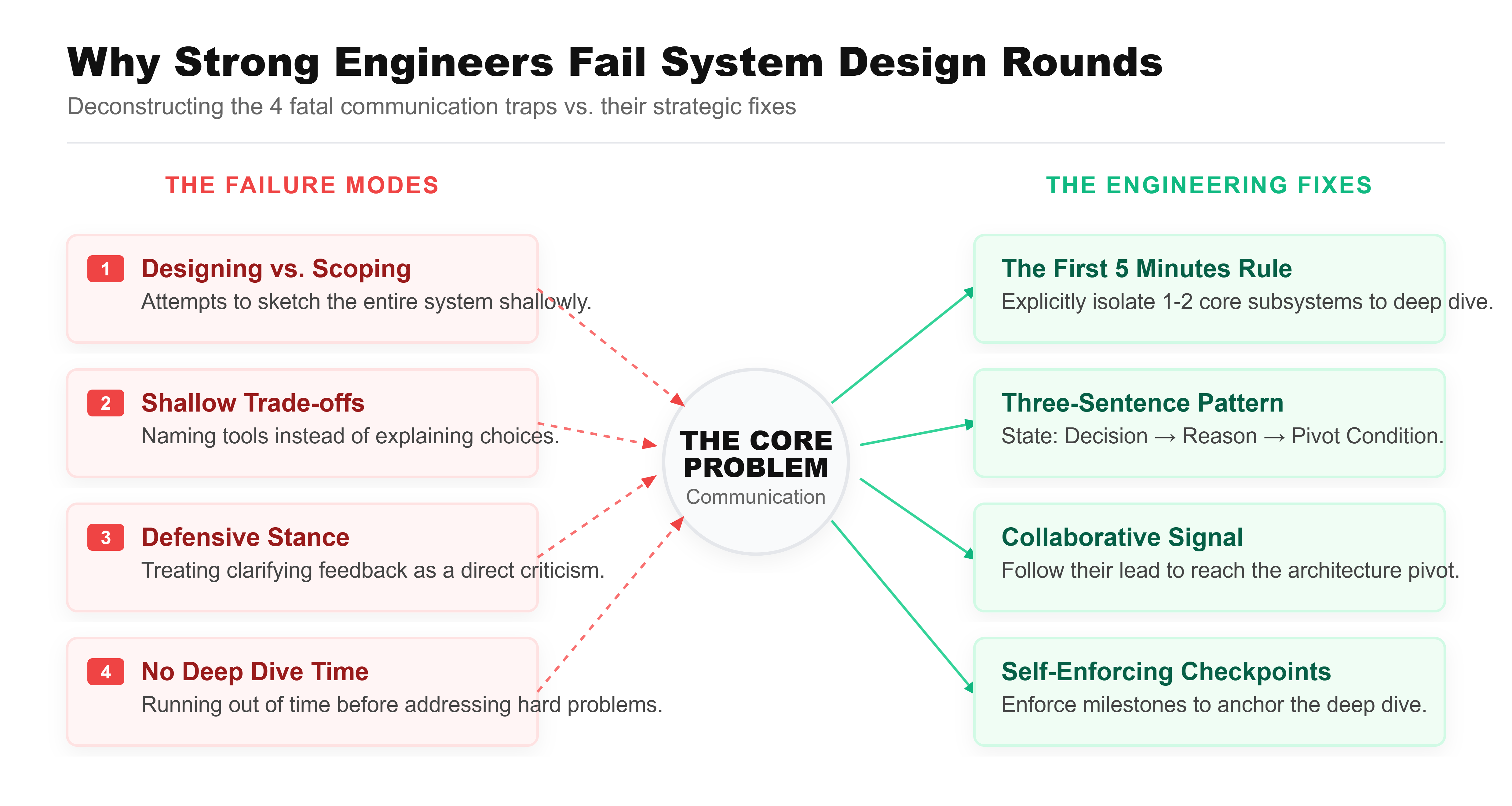
Failure mode 1: designing instead of scoping
The question is “design Twitter.” The candidate starts designing Twitter. The entire Twitter.
Fifty minutes is not enough time to design a system with the surface area of Twitter. Everyone who attempts to design all of it produces a shallow sketch of everything. The interviewer wanted a deep design of one or two components. The candidate gave a shallow design of twelve.
The fix is the first five minutes of the interview. Use them to scope explicitly: “There are several interesting subsystems here. For this interview, I’m going to focus on the timeline and the fan-out architecture. I’ll acknowledge notifications, search, and ads exist but won’t design them — does that work for you?”
Most interviewers say yes. If they don’t, they redirect you to what they actually want to probe. Either way you’ve avoided spending 45 minutes designing the wrong thing.
Failure mode 2: communicating at the wrong level
“I’d use a database for user data and a cache for performance.”
This sentence tells an interviewer almost nothing. Which database? Which cache? What’s being cached? Why? What’s the eviction strategy? What happens on cache miss?
The problem isn’t that the candidate doesn’t know the answers. They often do. The problem is they’re communicating at the level of “I’ve heard of these technologies” rather than “I understand the trade-offs.”
The fix is the three-sentence pattern: the decision, the reason, and the condition under which you’d change your mind. “I’d use Redis for the timeline cache with LRU eviction and a 24-hour TTL. The hot read pattern is point lookups by user_id, and Redis’s sub-millisecond gets absorb the read load that would otherwise hit Postgres on every feed request. If the working set grows beyond 20% of total DAU being simultaneously active, I’d evaluate a tiered cache.”
That’s the same knowledge communicated at the right level.
Failure mode 3: treating the interviewer as an adversary
The design round is not an oral exam. The interviewer is not trying to catch you out.
Candidates who treat it like an exam defend their choices when challenged, interpret probing questions as criticism, and become less flexible as the round goes on. The interviewer asks “what if the scale was 10× what you assumed?” and the candidate hears “your estimation was wrong” and gets defensive.
The more useful interpretation: the interviewer is helping you get to the interesting part of the question. When they push back, follow their lead. “Good point — at 10× scale, the component that breaks first is the Postgres write path. Let me address that.”
Failure mode 4: running out of time before the deep dive
The deep dive — the hard distributed systems problem at the center of the question — is where the round is decided. It’s where L5 candidates separate from L4, and where L6 candidates separate from L5.
It’s also the section that gets cut when time runs out.
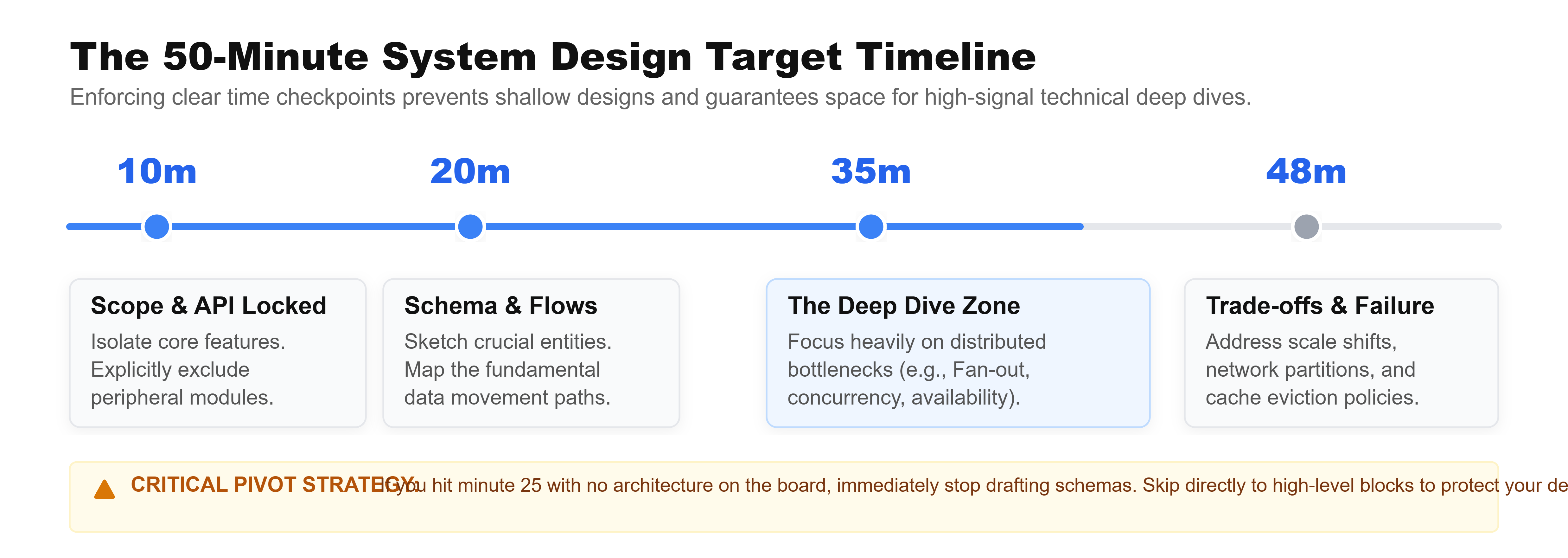
The fix is self-enforcing time checkpoints. Minute 10: API must be drafted, scope locked. Minute 20: schema and key flows sketched. Minute 35: deep dive in progress. Minute 48: trade-offs and failure modes underway.
If you’re at minute 25 with no architecture on the board, the correct move is to stop wherever you are, skip to the architecture, and do it roughly. A rough architecture with a deep dive is more valuable than a complete schema with no architecture.
The pattern
All four failure modes are communication problems, not knowledge problems.
If you’ve done the technical prep and you’re still not passing, the problem is almost certainly one of these four. The fix is not more reading. It’s a timed mock interview with someone who will score you specifically on scope management, communication depth, interviewer collaboration, and time allocation.
Knowledge gets you to the room. Communication gets you the offer.
CTA: If you recognise one of these four failure modes in your own prep — reply and tell me which one. I answer every reply and if you describe your specific situation I’ll point you to the right resource.
Subscription link
https://systemdr.systemdrd.com/subscribe
—Sumedh
The Question Vault has all 52 walkthroughs organized by archetype — so you can see the pattern across questions, not just the surface answer.
Access all 52 Quesstions here
I see the exact same scoping failure in financial planning.
Clients want to plan for everything at once — retirement, kids' education, a house, gold — and end up with shallow coverage everywhere. The three-sentence pattern applies: the decision, the reason, and when you'd change it. That's what separates a real plan from an insurance pile.
Engineers who fail design rounds over-insure, chase returns, and never commit to a clear plan.